
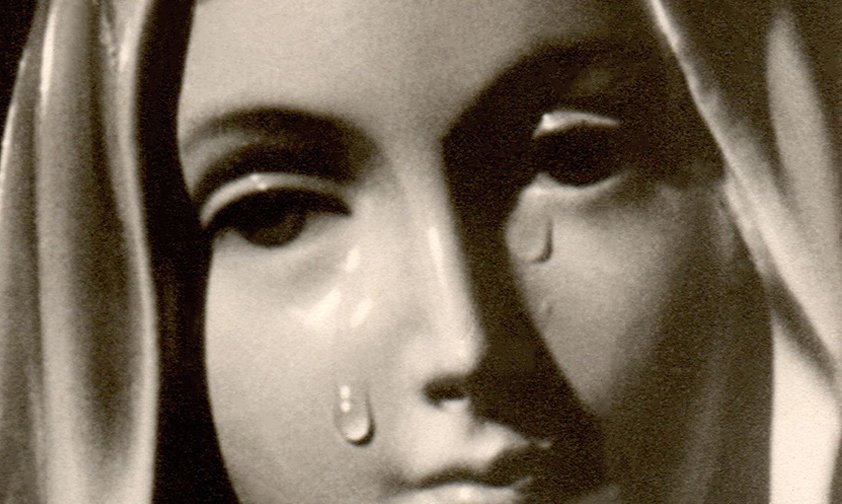
In Syracuse (Italy), in memory of Our Lady's tears that flowed from August 29 to September 1, 1953 from a painted plaster bas-relief representing her Immaculate Heart, a majestic sanctuary was built in the heart of the city. The young married couple who owned the image as well as the inhabitants of the entire city were protagonists of this event. This "sign," recognized very quickly by the Church, transcends time and distance, transmitting to this day an eloquent message: God's tenderness toward humanity.
The Event
On the morning of August 29, 1953, the feast day of the octave of the Immaculate Heart of Mary, at the home of the young married couple Angelo Iannuso and Antonina Giusto, living at No. 11 via degli Orti di San Giorgio in the suburbs of Syracuse (Sicily, Italy), the painted plaster bas-relief representing the Immaculate Heart of Mary and placed at the head of the Iannuso spouses' bed, began to shed tears, while Antonina, ill and bedridden, experienced a difficult pregnancy. Twenty years before the tears of Our Lady of Akita (Japan), a pious object of the Virgin weeps. The phenomenon repeats itself 58 times, at more or less regular intervals, for four days (August 29-30-31 and September 1), both inside the house and outside, where the image was placed on display. Thousands of people saw, touched, collected and tasted these tears. This prodigy was photographed and videotaped. On the second day of the lacrimations, August 30, an amateur filmmaker, Nicola Guarino, captured in 300 frames the formation and flow of the tears. On the mandate of the diocesan curia, on the morning of September 1, an investigation commission consisting of experts from the provincial hygiene laboratory went to the Iannuso family home and took more than one cubic centimeter of the liquid flowing from the eyes of the image. The results of chemical analyses under the microscope reveal that the liquid has a "composition analogous to human lachrymal secretions," it shows traces of proteins and urates, the same substances that compose our tears. Once the analysis was completed, at 11:40 a.m., the lacrimation phenomenon ended. We were on the fourth day.
Healed and Converted Witnesses
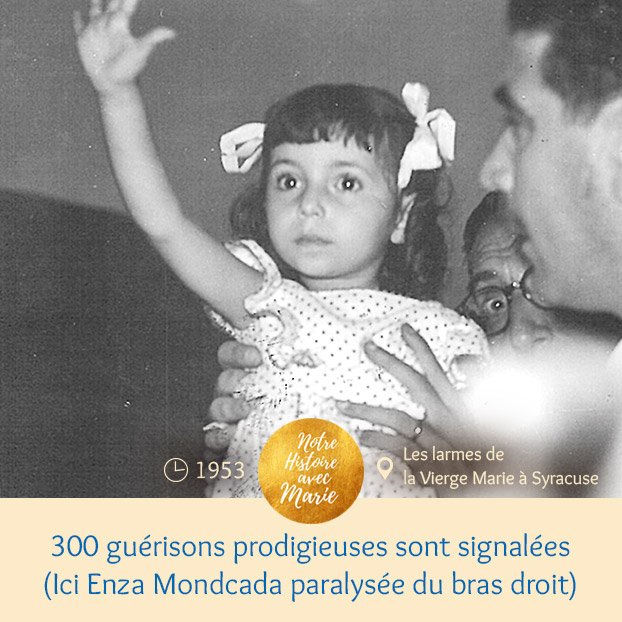
The ecclesiastical tribunal of Syracuse, instituted for this occasion, gathered the depositions of 188 witnesses. On October 7, 1953, a medical commission was instituted to analyze the testimonies relating to approximately 300 miraculous healings reported by mid-November. It is particularly interesting to highlight the healings of Antonina Giusto Iannuso (toxemia of pregnancy), Enza Mondcada (paralysis of the right arm) and Anna Gaudioso Vassallo (epithelioma of the rectum). The healings occur following the invocation of "Our Lady of Tears" and after placing cotton soaked in the tears from the painting on the sick part of the body. In addition to physical healings, the lacrimations also produce spiritual healings: the most famous is that of Michele Cassola, member of the Commission that analyzed the tears, who did not believe at the time of the inquiry, but who opened his heart to faith after twenty years of inner struggle.
The Voice of the Church
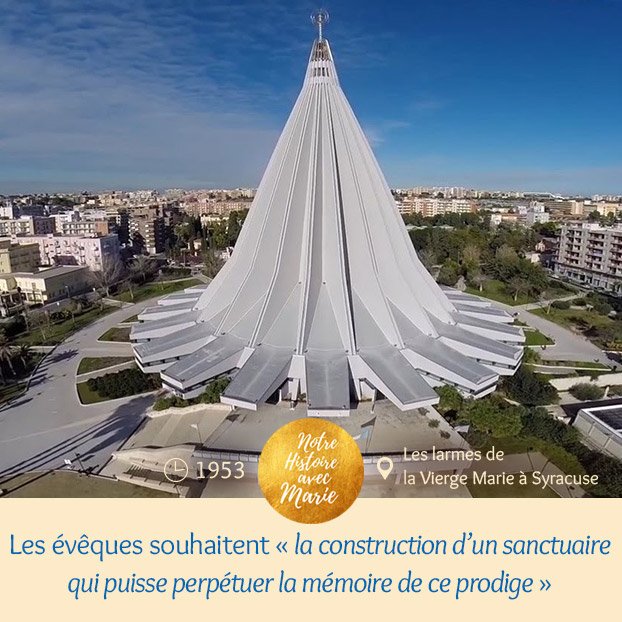
The verdict of the Magisterium is immediate. On September 8, 1953, the archbishop of Syracuse, Monsignor Ettore Baranzini, attested to the authenticity of the phenomenon. Three months later, on December 12, the Sicilian Episcopate confirmed through the voice of Cardinal Ernesto Ruffini: "One cannot doubt the reality of the lacrimations"; and they wish for "the construction of a sanctuary that could perpetuate the memory of this prodigy."
The Sanctuary
The sanctuary represents the Church's and the city of Syracuse's first concrete response. Initially, the small bas-relief is displayed for the devotion of the faithful in a "tent-church" located in Piazza Euripide, close to the house of the lacrimations. Later, it is placed in a new and modern sanctuary. Built in several stages, it consists of two independent churches: the crypt, completed in 1968, and the upper basilica, finished in 1994 and dedicated by Saint John Paul II on November 6 of the same year. Work of French architects Michel Andrault and Pierre Parat, its form suggests the plastic transposition of the idea of humanity rising toward God. The reinforced concrete roof indeed recalls an immense robe 74 meters high, flared at the bottom (80 meters in diameter at the base). This place which aims to preserve the memory of the prodigy and which houses the painting in question is the site of very numerous local, national and international pilgrimages.
The Reliquary
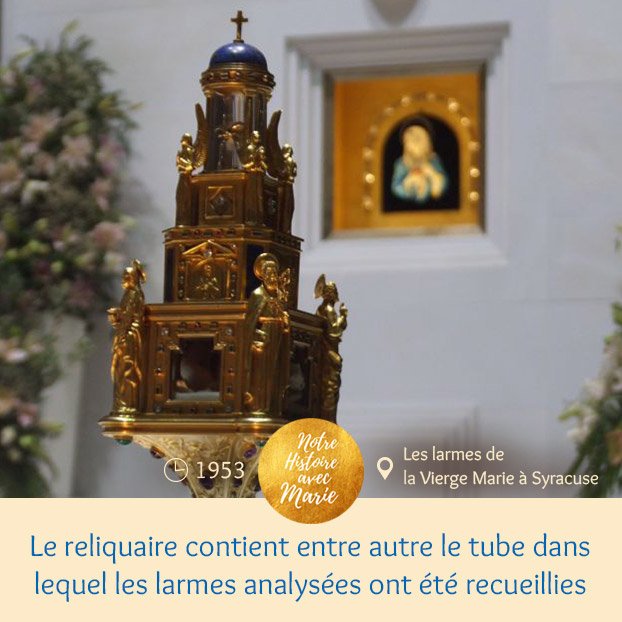
On May 8, 1954, the precious reliquary that preserves in an ampule the remaining tears after the scientific inquiry is sealed. Made by artist Biagio Poidimani, it also contains handkerchiefs as well as cotton balls used to dry the face of the painting and the tube in which the analyzed tears were collected. This reliquary sometimes travels to other dioceses in Italy or elsewhere for short-term Marian missions.
The Popes and the Tears of Mary
Official speeches addressing the Syracuse event are numerous. The most eloquent words are drawn from the speeches of Popes Pius XII, John Paul II, Benedict XVI and Francis. These are radiant words spoken in different historical contexts but which have never ceased to spread their light to illuminate the new challenges of the time to come.
On October 17, 1954, barely a year after the events, Pius XII was the first Pope to pronounce on the facts of Syracuse at the occasion of the Marian Congress of Sicily.
From John Paul II, there are eighteen speeches on this subject. Some of them were pronounced during his pastoral visit to Syracuse on November 5 and 6, 1994 for the dedication of the sanctuary to the Virgin of Tears. As a young bishop, Karol Wojtyla was a pilgrim in Syracuse and celebrated the Eucharist at the foot of the miraculous image. Having become Pope, he stopped twice to pray before the reliquary of Mary's tears.
From Benedict XVI, there is only one but precious reference to the lacrimations of Syracuse, words written when he was not yet the sovereign pontiff of the Roman Church, but Cardinal Joseph Ratzinger. His words are preserved in one of his books written in memory of his predecessor.
The Message of the Tears
"Will men understand the mysterious language of these tears?", Pius XII asks himself in a historic message broadcast on the radio on October 17, 1954. In the sermon for the dedication of the sanctuary to the Virgin, John Paul II affirmed in 1994: "The tears of Mary belong to the order of signs." "Sign" which, while remaining mysterious, allows us to see the Heart of Mary and that of God, expresses the tears of the Church, which summarizes those of all humanity and pa.
Complements
1. The Tears of Mary in the History of the Church
The tears of Mary are not an isolated phenomenon in the history of the Church. They appear in various contexts and at different times, often as a sign of compassion and divine intercession. Among the most famous examples, we can cite:
Our Lady of La Salette (1846): The tears of the Virgin at La Salette in France are a call to conversion and penance.
Our Lady of Akita (1973-1981): The tears of the Virgin in Japan are associated with messages of prayer and repentance.
These apparitions, although different in their contexts and messages, share a common theme: Mary's suffering for humanity and her call to conversion.
2. The Syracuse Sanctuary Today
The sanctuary of Syracuse is today an important pilgrimage site, not only for Sicilians, but also for the faithful throughout the world. It welcomes thousands of visitors each year, drawn by spirituality and devotion to the Virgin of Tears. The sanctuary also organizes spiritual retreats, conferences and liturgical celebrations to deepen understanding of Mary's message.
3. The Reliquary of Tears
The reliquary of Mary's tears is an object of great devotion. It is often displayed in different churches and sanctuaries throughout the world, allowing the faithful to pray before this tangible testimony of Mary's presence. The reliquary is also a symbol of the unity of the Church, as it travels and gathers the faithful around a common message of peace and mercy.
Documentary Sources
Archives of the Diocese of Syracuse: Official documents and testimonies collected by the ecclesiastical tribunal of Syracuse.
Scientific Analyses: Reports from the provincial hygiene laboratory of Syracuse, dated September 1, 1953.
Papal Speeches:
Pius XII, Radio Message, October 17, 1954.
John Paul II, Homily for the Dedication of the Sanctuary, November 6, 1994.
Benedict XVI, Reflections on the Tears of Mary, in a book dedicated to John Paul II.
Testimonies of Healings: Reports from the medical commission instituted on October 7, 1953.
Articles and Books:
Madonna delle Lacrime, official journal of the sanctuary of Syracuse.
The Tears of Mary, by Rosaria Ricciardo, contributor to the journal Madonna delle Lacrime.
Source: Our History with Mary