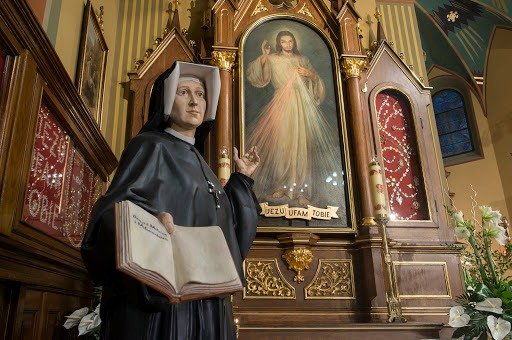
The second Sunday of Easter, known today as Divine Mercy Sunday, is not a celebration that arose simply through liturgical development, but rather the fruit of a concrete request from Christ to Sister Faustina Kowalska, which in time was embraced by the entire Church.
According to the Polish saint's account in her spiritual diary, Jesus expressed his desire that this day be dedicated in a special manner to divine mercy, even indicating its place in the calendar: the first Sunday after Easter.
A Call Directed Especially to Sinners
The nucleus of this devotion is not abstract, but profoundly concrete: to offer souls, and in a particular way sinners, a refuge in God's mercy.
In the revelations to Sister Faustina, Christ presents this feast as a singular moment of grace, in which the faithful are invited to approach the sacraments with confidence. Confession and communion acquire a central role on that day, linked to the promise of profound spiritual renewal.
A Grace That Demands Interior Disposition
The spiritual tradition surrounding this feast insists that it is not automatic, but rather a grace that requires clear conditions: sincere confession, eucharistic communion, and an interior attitude marked by confidence in God and charity toward one's neighbour.
Some theologians have emphasized the exceptional character of this promise, highlighting the intensity of grace linked to this celebration, always in continuity with the sacramental life of the Church.
The Plenary Indulgence on Mercy Sunday
To this spiritual dimension is added a concrete grace recognized by the Church: the possibility of obtaining a plenary indulgence on this day. Saint John Paul II officially established this concession in 2002, linking it to the celebration of Divine Mercy Sunday.
The plenary indulgence involves the total remission of the temporal penalties due for sins already forgiven, and may be applied both to oneself and to the souls in purgatory.
To obtain it, the faithful must fulfill the customary conditions: sacramental confession, eucharistic communion, and prayer for the intentions of the Pope, in addition to participating in acts of piety in honour of Divine Mercy.
The Church also contemplates the possibility of attaining this grace in special circumstances, such as in the case of the sick or persons unable to physically attend temples, provided they unite themselves spiritually to the celebration with the proper dispositions.
From a Local Devotion to a Universal Celebration
The spread of the Feast of Mercy was not immediate. For years it was celebrated in a limited manner in Poland, especially in the archdiocese of Kraków, before gradually extending.
It was Saint John Paul II, deeply marked by the spirituality of Sister Faustina, who took the decisive step in instituting this celebration for the entire Church in the year 2000, coinciding with the canonization of the saint.
Preparation and Significance of the Celebration
The Church proposes to prepare for this feast through a novena that begins on Good Friday, centred on the prayer of the Chaplet of Divine Mercy.
The significance of the celebration points to a deeper reality: to recall that mercy is not a secondary element of faith, but one of its most decisive expressions, especially in a time marked by the need for conversion.