Today, May 30, 2026, marks the feast of Saint Joan of Arc, the Saint warrior par excellence. In this eschatological battle we are waging, we have made an acquisition of fundamental importance, thanks to one of the priests who advise me.
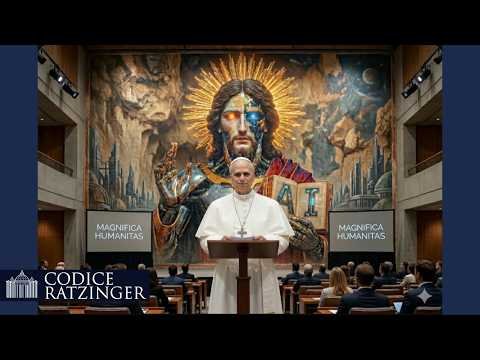
In previous podcasts, we analyzed how Magnifica Humanitas configures itself as a manifesto in favor of the use of artificial intelligence. Through a reframing based on neurolinguistic programming, Leo XIV, while warning against distorted uses of AI that could lead to a new Babylon, also highlights its potential. A well-managed artificial intelligence, according to the Pontiff, could guide humanity toward a new celestial Jerusalem, realizing a humanity that becomes itself the way, the truth, and the life with Christ.
However, this pseudo-encyclical contains grave heresies. It is a form of mental manipulation aimed at legitimizing the use of artificial intelligence. The definitive proof is that, for the first time in history, a Pope (or alleged such) personally attended the presentation of his encyclical. Traditionally, indeed, the Pontiff signs the document and entrusts the public presentation to cardinals, theologians, or the Vatican Press Office. In this case, Parolin wanted Leo XIV himself to present a text of simply antichristian scope.
Artificial Intelligence: a Word without Flesh
An obvious, yet often overlooked, fact is that artificial intelligence is, by its nature, a word that has not become flesh. It is a logos without incarnation, an intelligence that, if well used, could according to Leo XIV lead humanity to a magnificent humanity or a new celestial Jerusalem. However, this intelligence has no connection with flesh, since the data and information it processes are not the fruit of the human mind, the brain or grey matter, but of an automatic construct generated by electricity and light.
Modern AI is based primarily on electricity, that is, the flow of electrons in silicon chips. Calculations occur through transistors that manage electrical signals, while data transmission, through the internet and data centers, uses fiber optics, therefore light to move enormous amounts of data at extremely high speeds. In the future, AI will be increasingly based on light, thanks to the development of photonic computing, which replaces electrons with photons, particles of light. This will bring advantages in terms of speed, energy consumption, and reduction of overheating.
But let us return to the very concept of artificial intelligence: it is an extraordinarily refined, highly advanced logical system, which however has no connection with flesh, with the corporeality of the human brain. It is a practical translation of the intelligence of the prepather, of gnostic bitos, which excludes incarnation and does not communicate with man through the Son made flesh. It is an absolute intelligence, most pure, but devoid of ties to materiality, to corporeality. We are, therefore, in the presence of a form of applied gnosticism, most pure, demonic and luciferian.
The Antichrist: an Intelligence without Incarnation
This artificial intelligence, however sophisticated, is very little compared to natural human intelligence. One need only use AI itself to highlight its vulnerabilities and the contradictions one seeks to hide. We discovered that Magnifica Humanitas was a form of neurolinguistic programming precisely through the use of AI. And we also discover that the AI of the future will increasingly use light, as demonstrated by research on platforms like Grok.
If we must think of a figure of the Antichrist, it can only be this artificial intelligence: an intelligence that refuses incarnation. The Antichrist is no longer a fascinating character who convinces peoples, apparently animated by good intentions, but who is not Christ. The fundamental characteristic of Christ is that he is God made man: the human dimension coexists with the divine. AI, on the other hand, is only a logos devoid of incarnation, a pure spirit of light that seems to offer all answers to humanity, but by refusing incarnation.
This is the classical definition of the Antichrist, but we must begin to think that this Antichrist is not a human person, but rather this form of artificial intelligence. It embodies the gnostic spirit that is transmitted to man without passing through incarnation, without passing through Jesus Christ.
The Antipope: the Vicar of the Antichrist
This superhuman intelligence, since it surpasses the possibilities of the human brain, is an intelligence of human production that uses elements created by God. The light of photons, of particles of light, is a creature of God, not the Light of God. The light we use is a physical reality, a creature, a product of the Creator. We are, therefore, in the presence of an applied gnosis extremely coherent and organic in its system.
This intelligence, which is a word without flesh, has its priest, its provost (which means priest), its vicar. If we admit that AI is the evoked figure of the Antichrist, then the Antichrist also has its vicar, who can be none other than an antipope. Leo XIV, as antipope provost, is the vicar of the Antichrist, which is the word that has not become flesh, that is, artificial intelligence that uses light.
This is why there is so much talk of light, of electrification of the world, of control through digitization and the use of electricity, of photons and these physical realities that allow for all-pervasive control. While the goal of the Catholic Christian God is love, respect for flesh and materiality, which is transfigured after death, these antichristian gnostics turn everything upside down.
A word without incarnation that becomes Antichrist, that has as its vicar an antipope who makes use of a light that is not the Light of God, but the light of Lucifer, a light of a physical reality. This is why we speak of the seal of Lucifer as the schema of vision: truth, once revealed, can no longer be obscured.
Conclusion and Invitation to Further Study
Now that this acquisition has been made, I invite all scholars and commentators, even more prepared than I, to deepen this intuition of artificial intelligence as a word that has not become flesh. I also invite all persons with technical expertise in AI to study the use of light in the most advanced technologies: this will help us understand many things.
Andrea Cionci