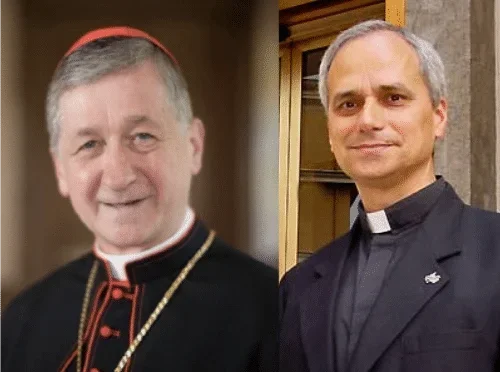
On September 25, 2026, Leo XIV stood in the Élysée Palace and praised France’s revolutionary motto, liberty, equality and fraternity, declaring that its principles find inspiration and fulfillment in the Gospel. He also credited the French Enlightenment with important advances in human rights, particularly religious freedom.
The contrast deserves disgust.
The French revolutionary authorities who persecuted the Church confiscated ecclesiastical property, suppressed religious communities, subordinated the clergy to the state and prosecuted priests who refused to submit. Revolutionary propaganda even displayed the extended slogan, Liberty, Equality, Fraternity—or Death. A surviving example appears in the Musée Carnavalet’s collection.
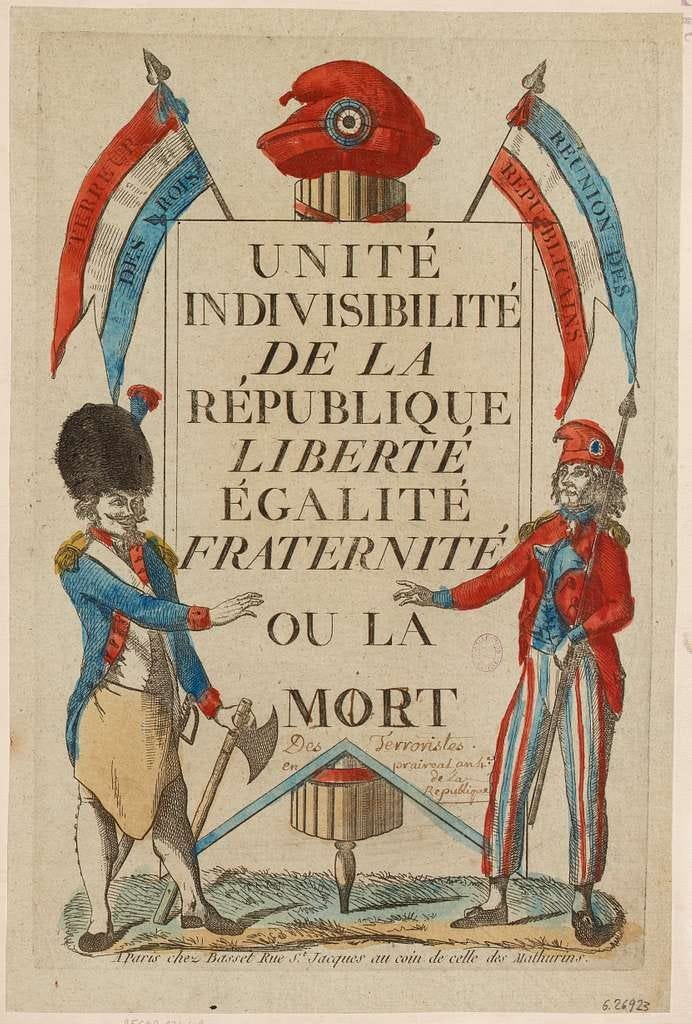
Nearly two and a half centuries later, a man claiming the succession of the popes who condemned those revolutionary principles stood before the government of France and offered its national motto praise.
He did so without confronting the historical context that his predecessors considered indispensable.
Pius VI Already Put This Revolution on Trial
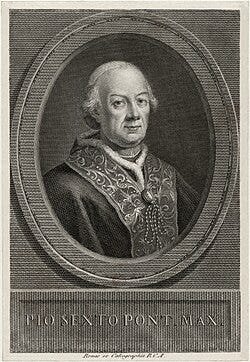
The appropriate starting point is Pius VI, who actually confronted the Revolution while it was happening.
In Quod aliquantum, issued on March 10, 1791, he condemned the Civil Constitution of the Clergy and challenged the revolutionary Assembly’s understanding of liberty and equality. In particular, he rejected the supposed natural right to unrestricted freedom in religious opinion and expression. He regarded that conception of liberty as incompatible with man’s obligations to God and the authority of the Church.
Pius VI was dealing with something more consequential than a debate over terminology. The French state was attempting to reorganize Catholic ecclesiastical life according to revolutionary political principles.
The state would determine ecclesiastical boundaries. It would intervene in the appointment of bishops and priests. Clergy would be required to swear allegiance to the new arrangement.
Those who refused were treated as enemies of the Revolution.
Later events demonstrated how little protection revolutionary declarations offered Catholics unwilling to abandon their religious obligations.
Leo XIII subsequently gave a systematic account of the underlying problem in Immortale Dei. He criticized theories of government that locate the ultimate source of authority in the people while excluding society’s obligations to God. He also rejected the claim that the state must regard every religion as equally true or equally entitled to its positive endorsement.
The same encyclical explicitly distinguished these condemned principles from legitimate political participation, lawful liberty and prudent religious toleration.
That distinction is indispensable.
Pius VI and Leo XIII taught that the revolutionary philosophy that severed those concepts from divine law and the rights of the Church was inherently wicked.
Yesterday, Leo XIV used the same vocabulary that occasioned those condemnations while offering almost none of the corresponding theological distinctions.
The question is why.
The Martyrs Missing From the Élysée Speech
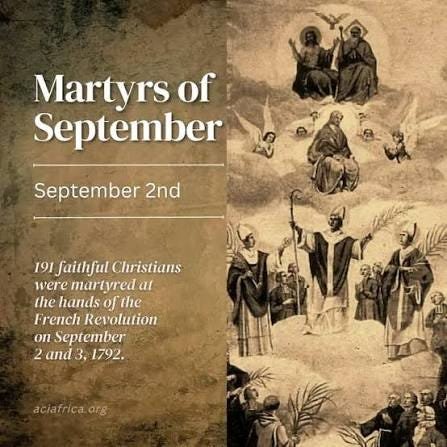
Leo’s remarks were especially striking because he began by praising France’s Christian inheritance.
He invoked St. Irenaeus, the baptism of Clovis, the French intellectual tradition and the magnificent restoration of Notre-Dame. He then moved through the Renaissance and Enlightenment to the modern language of human rights and France’s national motto.
The sequence creates a smooth narrative of historical “progress.”
Christian France contributes to civilization. The Enlightenment advances human rights. Revolutionary France supplies liberty, equality and fraternity. Leo explains how those principles find fulfillment in the Gospel.
The history of the Church’s persecution during the Revolution disappears from the account.
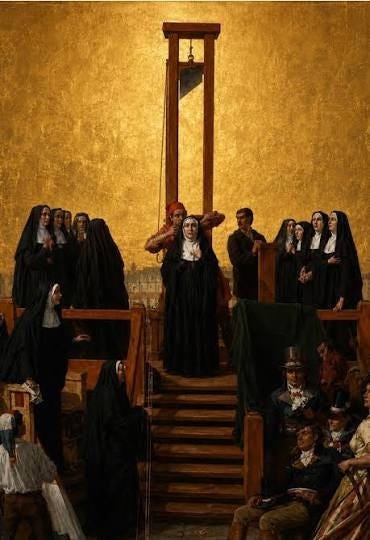
The sixteen Carmelites of Compiègne would have complicated that narrative considerably.
So would the refractory clergy who endured imprisonment and deportation rather than submit to revolutionary control. So would the suppression of religious communities and the transformation of churches into instruments of revolutionary civic religion.
A Catholic bishop addressing the French government need not devote his entire speech to eighteenth-century persecution. But when he chooses to praise the Enlightenment’s contribution to religious freedom and interpret the revolutionary motto through the Gospel, the omission becomes theologically significant.
The Revolution’s treatment of Catholics was directly connected to its understanding of political sovereignty and religious authority.
A discussion of its liberty that omits that conflict gives an incomplete account of what the revolutionary authorities believed liberty permitted them to do.
There is an obvious Catholic alternative. Leo could have affirmed genuine liberty, equality before God and fraternity in Christ while explicitly recalling the disastrous consequences of their revolutionary reinterpretation.
Instead, he left the distinction largely unstated.
His separate condemnation of threats to unborn and vulnerable human life, his defense of Catholic education and his criticism of coercive secularism are genuine parts of the speech. They also demonstrate that he had no difficulty introducing explicitly Catholic moral principles when he considered them necessary.
The unresolved question is why the same clarity was missing when he addressed the Revolution’s central political inheritance.
The Crown of Thorns Cannot Be Separated From Christ’s Kingship
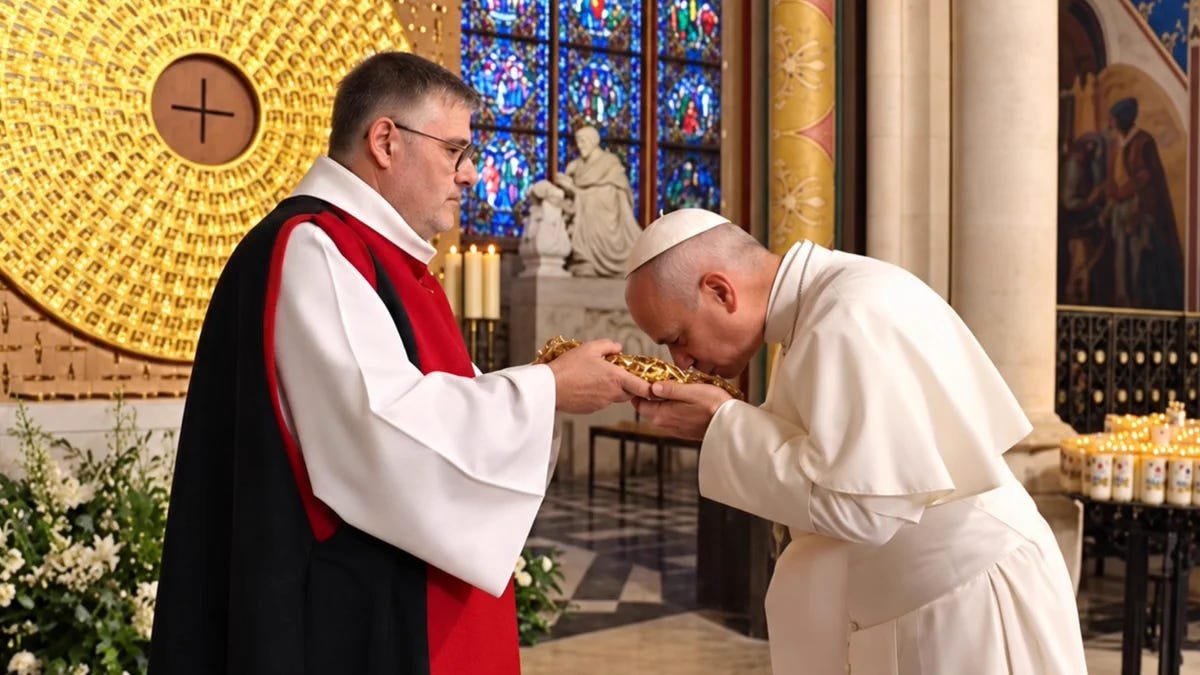
("And Jesus said to him: Judas, dost thou betray the Son of man with a kiss?")
Later that afternoon, Leo visited Notre-Dame and venerated the Crown of Thorns before presiding at Vespers.
The two appearances created a remarkable theological juxtaposition.
At the Élysée, he praised the ethical possibilities of the French republic’s national motto. At Notre-Dame, he venerated a relic associated with the suffering and kingship of Jesus Christ.
The Crown of Thorns recalls the King whose authority derives from God and whose kingdom places obligations upon every human conscience.
For traditional Catholic theology, the social kingship of Christ is therefore central to any account of political liberty.
Pius XI explained that principle in Quas Primas. Civil society cannot treat Christ’s authority as a merely private spiritual preference without diminishing its understanding of political obligation.
Leo XIII had developed the corresponding teaching concerning the duties of states in Immortale Dei.
The question raised by Leo’s visit concerns the relationship between those doctrines and his presentation of modern French secularism.
His Élysée speech proposed an understanding of secular government that welcomes religious contributions to the common good while protecting a diversity of consciences.
That framework differs substantially from the earlier papal teaching on the duties of Catholic societies toward the true religion.
The Crown of Thorns makes the missing question unavoidable: what authority does Christ possess over the public life of nations?
A Catholic account of liberty that leaves His kingship indistinct has failed to explain the very principle that earlier popes regarded as fundamental.
Rome’s Latest Document Gives Christ a Movement Instead of a Church
The speech in Paris did not emerge in isolation.
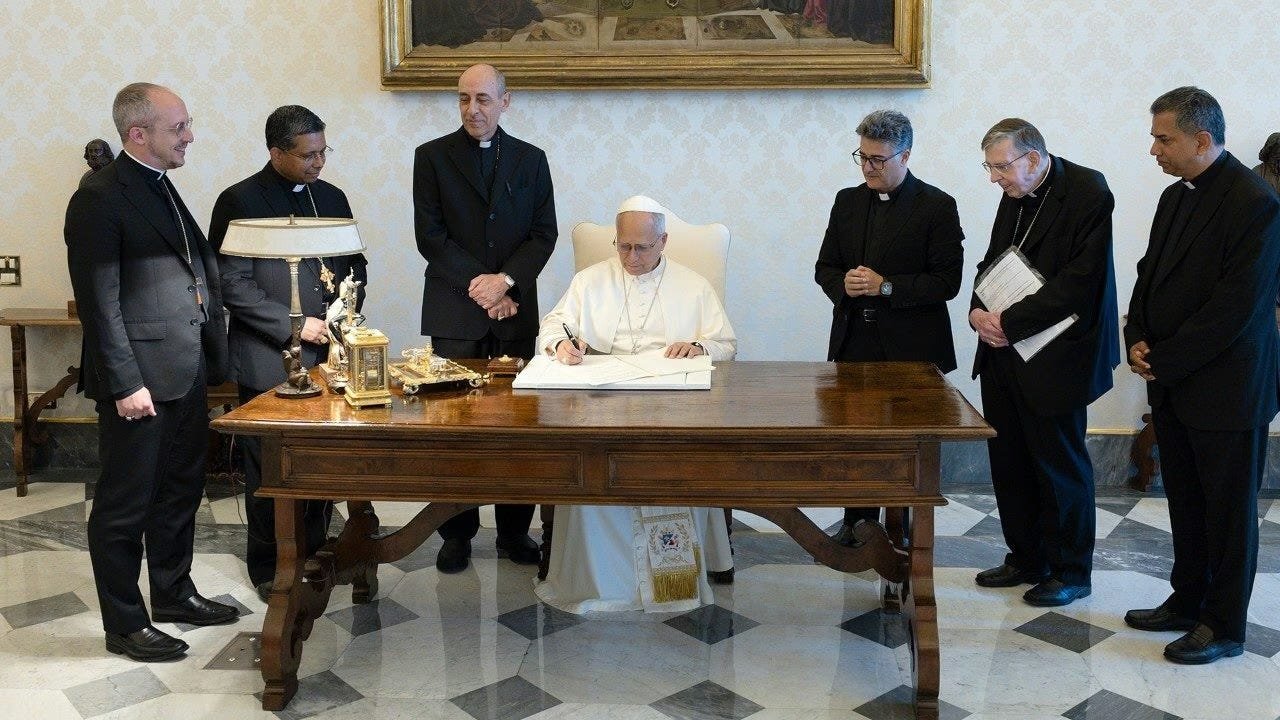
On September 16, three Vatican dicasteries published A Journey of Hope, commemorating sixty years of interreligious dialogue following Nostra Aetate. Leo had approved the document on June 22 and ordered its publication.
Its opening paragraph makes an unusually consequential claim: Nostra Aetate marked a profound change in the Church’s understanding and expression of her relationship with other religions.
The word “understanding” is doing important work there.
A change in diplomatic tone is one thing. A change in theological understanding raises a much more substantial question about continuity with previous Catholic doctrine.
Paragraph 10 compounds that difficulty.
It describes early Christianity as developing from a movement initiated by Jesus and His disciples, gradually distinguishing itself from contemporary forms of Judaism. The next sentence describes the first Christians as adapting inherited Jewish principles to their circumstances after Easter.
Christianity did emerge historically within a Jewish religious environment. The differentiation between early Christians and other Jewish communities unfolded over time.
But Catholic doctrine does not describe the Church’s divine foundation as the eventual product of that historical differentiation.
Christ established His Church. He chose the Apostles, entrusted primacy to Peter, instituted the Eucharist and commissioned His followers to baptize and teach all nations.
Those are constitutive acts, not merely stages in the development of a religious movement.
Pius XII explained the Church’s divine foundation in Mystici Corporis Christi. St. Pius X defended the same essential truth when he condemned the modernist reconstruction of Christian origins.
The historical account offered by the new Vatican note places its emphasis elsewhere.
St. Pius X Condemned This Vocabulary for a Reason
In Lamentabili sane exitu, the Holy Office condemned sixty-five propositions with the approval of St. Pius X.
Proposition 59 rejected the claim that Christ merely inaugurated a religious movement capable of adaptation to different historical circumstances instead of transmitting a determinate body of doctrine.
Proposition 60 rejected the theory that Christian teaching evolved successively from its original Jewish form through Pauline, Johannine and Hellenistic stages. Proposition 52 concerned the denial of Christ’s intention to establish an enduring Church.
The language of A Journey of Hope bears an unmistakable resemblance to the historical framework addressed by those condemnations.
The burden of explanation rests squarely upon the authors of a Vatican document that chooses such language while discussing the very subject on which Pius X insisted upon doctrinal clarity.
Why describe the Church primarily as the historical development of a religious movement when Catholic teaching provides a much more precise account of her origin?
Why emphasize adaptation while leaving Christ’s institution of the Church unstated at that crucial point?
The problem becomes especially serious because this document comes from the dicasteries responsible for doctrine, Christian unity and interreligious dialogue.
These are the very authorities charged with protecting the distinctions that their language now makes difficult to discern.
The Distinction Rome Keeps Leaving Unstated
The most troubling feature of these developments is their cumulative effect.
Leo’s Élysée speech emphasizes the Christian possibilities of France’s revolutionary motto while leaving the older papal condemnation of its revolutionary interpretation largely unaddressed.
The Vatican’s new document describes Christian origins through the language of historical movement and adaptation while leaving Christ’s divine institution of the Church insufficiently explicit at the critical point.
Traditional Catholic teaching treated distinctions between true and false religion, divine revelation and human development, legitimate liberty and religious indifferentism, and the Catholic Church and other religious bodies as essential to the integrity of the faith.
The contemporary language examined here repeatedly places its emphasis elsewhere.
That pattern is a serious challenge to claims of uninterrupted doctrinal continuity.
And Leo’s appearance at the Élysée supplies a particularly striking example because the historical conflict was so direct.
Pius VI confronted a revolutionary state attempting to subordinate the Church to its authority. Leo XIII subsequently explained why the political philosophy underlying such claims contradicted the Church’s understanding of society’s duties toward God.
Yesterday, Leo XIV praised the ethical promise of the revolution’s most famous slogan without clearly explaining that earlier judgment.
The sixteen Carmelites of Compiègne did not surrender their lives for an abstraction called fraternity. They died rather than abandon their obligations to Christ and His Church.
Their witness raises a question that no amount of diplomatic eloquence can evade.
When modern political or religious language conflicts with the Catholic faith, which must be corrected?
The language of the age, or the faith handed down?