
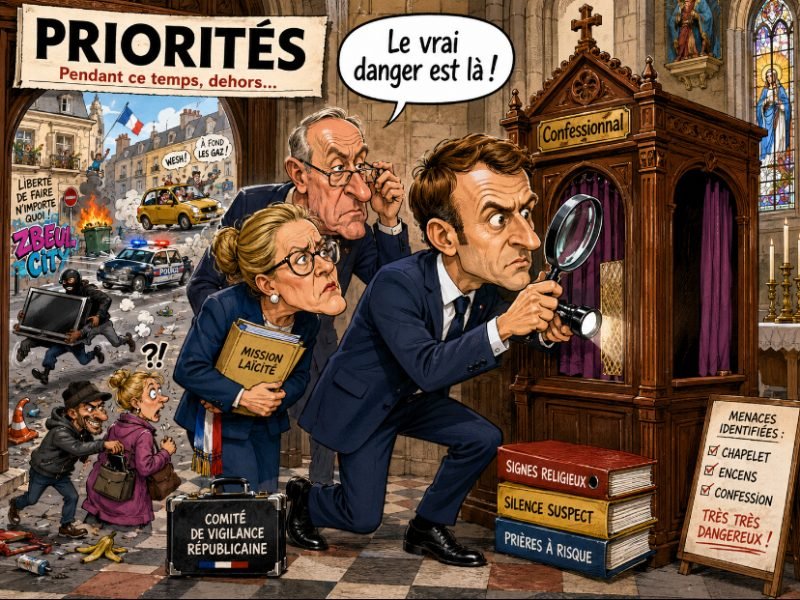
Bill No. 2708, filed on 28 April 2026, purports to « protect children and combat violence in schools ». Who could be against such an objective? No one in good faith. But its Article 9 goes much further: it explicitly intends to subject ministers of religion to the common reporting regime, setting aside the exception related to professional secrecy when serious violence against minors is known. In the parliamentary report, the intention is clear: to prevent the seal of confession from being assimilated to professional secrecy that could be invoked against this obligation.
The text is supported notably by Violette Spillebout, Member of Parliament for Ensemble pour la République, formerly Renaissance, and by Paul Vannier, Member of Parliament for LFI. It is therefore cross-party, or rather typical of this era when the government centre and the radical left can agree when it comes to trimming the concrete freedoms of the Church a little more.
The Conference of Bishops of France indeed reacted on 29 May 2026, warning of a text which, according to it, touches upon freedom of conscience, professional secrecy, freedom of worship and even freedom of education. It is right to be concerned: what is presented as a measure to protect minors actually introduces a very significant precedent in the relationship between the State and the sacramental life of the Church.
And this is where the situation becomes almost comical. Almost. For « Humour is the politeness of despair. »
Let us consider real France. The statistical service of the Ministry of the Interior published, in January 2026, its provisional assessment of insecurity and delinquency for the year 2025. Recorded physical violence increased by 5%. Sexual violence increased by 8%, rapes and attempted rapes by 9%. Homicides reached 982 victims, attempted homicides increased further by 5%. Drug use increased by 6%, trafficking by 8%, fraud by 8%, refusals to comply by 11%.
Alain Bauer has spoken for years of a return of violence against the body, of a society where thresholds for acting out are lowering. He recently summed up the climate with a terrible phrase: « nothing any longer prevents acting out ». One may debate one statistic or another, but the intuition is widely shared by the French: violence is not merely a statistic, it becomes an atmosphere.
And faced with this, what does one discover? That danger is being sought in the confessional.
Sociologically, the matter is vertiginous. Regular practising Catholics today form a small minority. The INSEE-INED survey of 2019-2020 already indicated that, among those aged 18-59 in metropolitan France, approximately one person in two declared a religion, and that Catholics formed the majority of religious affiliates; but, among these affiliates, only 14% declared attending a religious ceremony at least once a month.
An IFOP survey for Bayard-La Croix published in 2025 gives an even more eloquent order of magnitude: 46% of French adults say they are Catholic, but only 5.5% attend Mass at least once a month. As for confession, it concerns mainly a fraction of this fraction: approximately half of weekly Mass-goers and slightly more than a third of monthly Mass-goers declare they would go to confession.
In other words, the confessional is not exactly the great sociological crossroads of French delinquency. One would search long to find drug networks, violent gangs, those who refuse to comply, burglars, street attackers and hardened recidivists in the queue for the sacrament of penance, among an elderly reciting lady, a scrupulous father of a family and a student who comes to confess his laziness or his angers.
This obviously does not mean that a practising Catholic can never commit a crime. Sin runs through all humanity, including the pews of churches. But to act as if the seal of confession constituted a major lock on French criminal policy is less a matter of legislative seriousness than ideological theatre.
For after all, what happens in a confession? A priest does not keep an administrative desk there. He does not collect information for the State. He receives, within a sacramental framework, a conscience before God. If a culprit really comes to confess a crime, the role of the confessor is not to trivialize the act, but to lead towards truth, towards reparation, towards self-denunciation when it is necessary, towards the protection of victims, towards the exit from falsehood. Breaking the seal would not make criminals more talkative: it would simply dissuade them from coming to where a word of repentance can still be born.
This is the whole paradox. By seeking to transform the priest into a forced auxiliary of the judicial police, one does not necessarily protect victims better. One risks above all closing one of the very few places where a guilty man can still hear that he must cease, make reparation, surrender himself, change his life. The modern State loves to confuse efficiency with intrusion. It believes it solves a problem by violating a sanctuary.
Let the controls of institutions be reinforced, let predators be pursued, let children be protected, let complicity be sanctioned, let justice finally be given the means to judge quickly and well: yes, a thousand times yes. But let one not pretend to believe that France will regain control of its violence by installing the Republic in the confessional.
There is almost a burlesque inversion of priorities here. Official figures describe a society where physical, sexual, social and criminal violence is progressing on several fronts. Criminologists alert to the disinhibition of acting out. The French see clearly what is happening in transport systems, in certain streets, in certain institutions, in certain families, in certain neighbourhoods, in trafficking and in violence perpetrated by minors. And meanwhile, part of the political class designates the sacramental seal as if it were one of the hidden knots of French insecurity.
No: the confessional is not the safe of national delinquency. It is one of the last places where one still dares to say that evil is evil, that fault exists, that forgiveness is not an excuse, that reparation is necessary, that conscience cannot be reduced to a procedure.
The Republic has nothing to gain by trampling upon what it no longer understands. It has much to lose, on the other hand, by making religious freedom an emotional adjustment variable. A State confident in itself protects children, pursues criminals, respects cults and understands the difference between a secret that protects crime and a secret that protects the very possibility of moral conversion.
When power no longer knows how to hold the street, it is always tempted to rummage through the sacristy. This is perhaps the most despairing thing. Or the most amusing, if one remembers that humour remains, sometimes, the last politeness of despair.