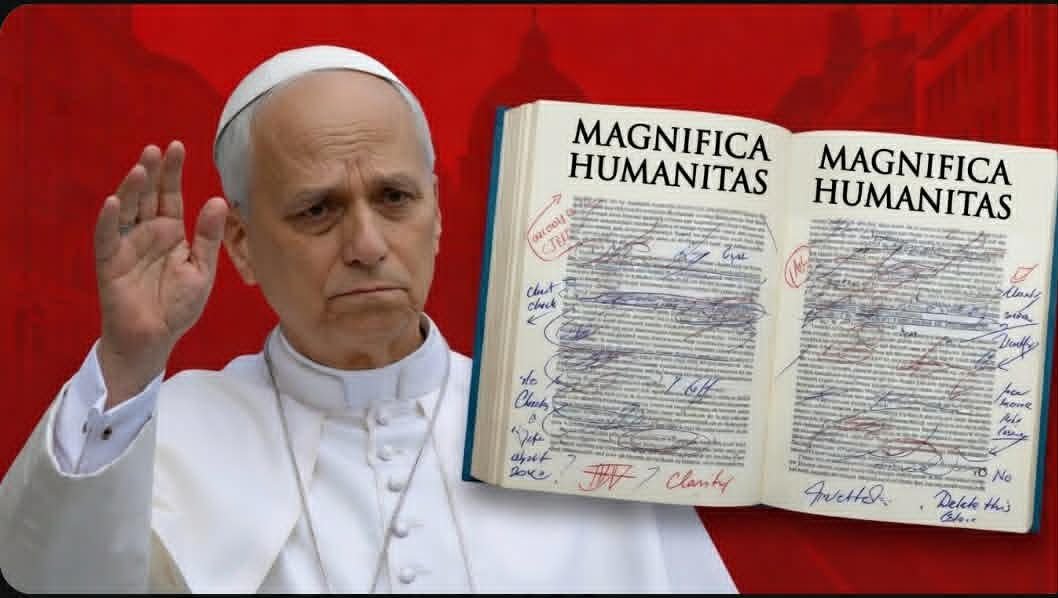
On the Title: Humanitas
The very title raises significant questions. In classical Latin, humanitas does not above all mean « humanity » in the modern and collectivist sense of the term, but rather the formation of man, culture, moral education, and refinement of the soul. In authors such as Cicero the word evokes the ideal of the virtuous and cultured man, not the exaltation of humanity as such.
The impression, however, is that the title is adopted in a strongly anthropocentric key; at the center no longer appears God who saves fallen man, but man himself elevated almost as an interpretive principle of faith. It is a dangerous inversion. Christianity does not arise from man's admiration for himself, but from the necessity of his redemption. Human dignity exists because man is created by God and redeemed by Christ, not because historical humanity is « magnificent » in itself.
A Church that ceases to speak first and foremost of God in order to speak of man inevitably ends up becoming secularized.
1) Paragraph 1 « This Magnificent Humanity ».
« In Jesus Christ, this humanity in its grandeur becomes the Way, the Truth and the Life ».
This formulation appears gravely ambiguous on the theological plane. In the Gospel of John (14,6) it is not « humanity » that is the Way, the Truth and the Life; it is Christ himself, the eternal Son of God incarnate.
« I am the Way, the Truth and the Life ».
To attribute, even implicitly, such a prerogative to humanity means to shift the emphasis from the saving divinity of Christ to a kind of exaltation of the human. But the Catholic faith does not teach that man saves himself or that humanity possesses in itself a redemptive capacity. It is God who saves man, not man who elevates himself.
Even more problematic is the expression « magnificent humanity ». After original sin, human nature is wounded, inclined toward evil, darkened in intellect and weakened in will. Certainly it retains its ontological dignity, but to speak of humanity in almost triumphal terms without recalling the reality of sin risks ending in a sentimental humanism incompatible with Christian realism.
The Cross exists precisely because man cannot save himself.
Many passages of the text seem to reflect that progressive shift from the theocentric order to the anthropocentric one that numerous pontiffs of the past had regarded with extreme concern.
Pope Pius X, in Pascendi Dominici Gregis, denounced modernism as the attempt to adapt the Catholic faith to the changeable categories of modern consciousness, progressively dissolving dogma into human sensitivity.
Similarly Pope Pius IX, in the Syllabus, rejected the idea that religion ought to be reconciled with the principles of modern relativism and absolute human autonomy.
Vatican Council II also, in Lumen Gentium 1 teaches that: « Christ is the Light of nations. Because this is so, this Sacred Synod gathered together in the Holy Spirit eagerly desires, by proclaiming the Gospel to every creature,(1) to bring the light of Christ to all men, a light brightly visible on the countenance of the Church. Since the Church is in Christ like a sacrament or as a sign and instrument both of a very closely knit union with God and of the unity of the whole human race, it desires now to unfold more fully to the faithful of the Church and to the whole world its own inner nature and universal mission. This it intends to do following faithfully the teaching of previous councils. The present-day conditions of the world add greater urgency to this work of the Church so that all men, joined more closely today by various social, technical and cultural ties, might also attain fuller unity in Christ. »
Christ is the light of nations and the Church has no other mission than to reflect the light of Christ to the world, not to replace it with a celebration of the human.
2) Paragraph 10. Synodality and the Dissolution of Truth
« Within this shared task, Christians discover their unique role of guiding actions toward God so that, in his light, pluralism does not dissipate into disorder, but instead, through the practice of synodality, it becomes the space in which humanity rediscovers its solid foundations and its final end »...
Here emerges clearly the drift of modern synodal ecclesiology; the idea that dialogue, pluralism and the comparison of positions can constitute the privileged place of truth.
But the Church is not born from dialogue. It is born from Revelation.
Truth is not constructed synodally, nor produced by human consensus. Truth was delivered by Christ to the Church once and for all. The Church's task is not to reinvent it through continuous processes of mutual listening, but to guard it faithfully and transmit it integrally.
The language of « synodality » is here elevated almost to a universal saving principle. This is precisely the danger: namely, to substitute the primacy of Truth with the primacy of process.
But pluralism saves no one. Fallen humanity does not find its end by speaking endlessly with itself. It finds it by converting to the law of God and adhering to Christ.
Without an objective and transcendent truth, synodality risks becoming a new ecclesial Babel, no longer the imposed uniformity, but the chaos of relativized opinions, masked under the name of « harmony ».
The impression is that of a Church that now fears the clear affirmation of truth more than doctrinal confusion.
Catholic faith, however, is not born from ecclesial consensus nor does it evolve according to the changing sensitivities of history. The deposit of faith was entrusted once and for all to the Church and must be guarded faithfully, not reinterpreted according to contemporary anthropological paradigms.
The Code of Canon Law indeed states:
« A person must believe with divine and Catholic faith all those things contained in the word of God, written or handed on, that is, in the one deposit of faith entrusted to the Church, and at the same time proposed as divinely revealed either by the solemn magisterium of the Church or by its ordinary and universal magisterium which is manifested by the common adherence of the Christian faithful under the leadership of the sacred magisterium; therefore all are bound to avoid any doctrines whatsoever contrary to them. » (can. 750 §1).
And again: « Each and every thing which is proposed definitively by the magisterium of the Church concerning the doctrine of faith and morals, that is, each and every thing which is required to safeguard reverently and to expound faithfully the same deposit of faith, is also to be firm-ly embraced and retained; therefore, one who rejects those propositions which are to be held definitively is opposed to the doctrine of the Catholic Church. » (can. 750 §2).
Already Pope Benedict XVI had forcefully denounced the « dictatorship of relativism », that is, the modern tendency to substitute truth with permanent dialogue, doctrine with process, faith with the changeable consensus of consciences.
Vatican Council II also, in Dei Verbum, teaches that the living Magisterium of the Church is the only authentic interpreter of the Word of God, not fluid processes of doctrinal renegotiation.
In this perspective, pluralism elevated to a positive principle risks dissolving the very notion of revealed truth. But for Catholicism Truth is not the result of a comparison between opinions: it is Christ himself, entrusted to the Church so that it be proclaimed integrally « opportune et importune ».
3) Paragraph 12. The Substitution of Sin with « Fragility »
« Secondly, building for the common good means accepting the limits and weakness of humanity without considering them an error to be corrected ».
This sentence perfectly represents one of the most dangerous tendencies of contemporary pastoral care: namely, to substitute the language of sin with that of fragility.
Certainly man is fragile. But Christianity is not limited to noting fragility; it calls evil by its name.
When the Church ceases to speak of sin, it inevitably ceases also to speak of conversion, penance, spiritual struggle and holiness. Everything is reinterpreted psychologically, therapeutically, emotionally.
But Christ did not come simply to « understand » man; He came to free him from sin.
To say that certain errors should not be « corrected » means to strike directly at the Church's very mission. What good then are moral preaching, confession, asceticism, fraternal correction, the evangelical call to conversion?
Christian mercy does not consist in confirming man in his fallen state, but in leading him to the truth that saves. A Church that no longer corrects inevitably ends up blessing the world rather than converting it.
The Catholic tradition has always clearly distinguished between mercy and permissiveness. Mercy saves the sinner by calling him to conversion; it does not redefine sin to make it acceptable.
Vatican Council II also teaches in Lumen Gentium 8 this: « the Church, embracing in its bosom sinners, at the same time holy and always in need of being purified, always follows the way of penance and renewal », thus implying the permanent recognition of sin and the necessity of conversion.
The Code of Canon Law also recognizes to the faithful the right and duty to defend the good of the Church: « According to the knowledge, competence, and prestige which they possess, they have the right and even at times the duty to manifest to the sacred pastors their opinion on matters which pertain to the good of the Church and to make their opinion known to the rest of the Christian faithful, without prejudice to the integrity of faith and morals, with reverence toward their pastors, and attentive to common advantage and the dignity of persons. » (can. 212 §3).
4) Paragraph 16. The Utopia of the « Common Dwelling »
« Thus, the “rejected stones” — the poor, the sick, the migrants and the least among us — will become the cornerstone, and a solid, welcoming common home will emerge on the earth, where love and faithfulness will finally meet, and righteousness and peace will embrace (cf. Ps 85:10). »
Here Christianity seems reduced to a universal humanitarian project. The language is that of an almost immanent global reconciliation, as if the fulfillment of biblical promises could be realized progressively through social and inclusive processes.
But the Catholic tradition teaches the opposite.
The Kingdom of God does not coincide with the political or social order of fallen history. Full reconciliation belongs to eschatology, not to human projects.
Without conversion to Christ there exists no authentic peace.
It is striking moreover that the « poor, sick, migrants, little ones » are evoked almost exclusively in a social key, while the Cross, judgment, grace, eternal salvation and the necessity of faith remain in the background.
The rejected stone is Christ. Not a sociological category.
Vatican Council II also, in Gaudium et Spes 39 emphasizes that: « We do not know the time for the consummation of the earth and of humanity, nor do we know how all things will be transformed. As deformed by sin, the shape of this world will pass away; but we are taught that God is preparing a new dwelling place and a new earth where justice will abide, and whose blessedness will answer and surpass all the longings for peace which spring up in the human heart. Then, with death overcome, the sons of God will be raised up in Christ, and what was sown in weakness and corruption will be invested with incorruptibility. Enduring with charity and its fruits, all that creation which God made on man's account will be unchained from the bondage of vanity.
Therefore, while we are warned that it profits a man nothing if he gain the whole world and lose himself, the expectation of a new earth must not weaken but rather stimulate our concern for cultivating this one. For here grows the body of a new human family, a body which even now is able to give some kind of foreshadowing of the new age.
Hence, while earthly progress must be carefully distinguished from the growth of Christ's kingdom, to the extent that the former can contribute to the better ordering of human society, it is of vital concern to the Kingdom of God.
For after we have obeyed the Lord, and in His Spirit nurtured on earth the values of human dignity, brotherhood and freedom, and indeed all the good fruits of our nature and enterprise, we will find them again, but freed of stain, burnished and transfigured, when Christ hands over to the Father: "a kingdom eternal and universal, a kingdom of truth and life, of holiness and grace, of justice, love and peace." On this earth that Kingdom is already present in mystery. When the Lord returns it will be brought into full flower. »
Therefore while valuing human progress, no historical project can be identified with the Kingdom of God and the ultimate destiny of man surpasses radically every earthly construction.
5) Paragraph 122. Universal Fraternity, Art and « Spiritual » Ambiguity.
« Finitude, when truly accepted, does not diminish us but opens us to recognizing the face of God and others. Indeed, precisely because we experience limits — vulnerability, suffering and failure — we can recognize the inviolable dignity of every person, both our own and that of others. In this same experience, we remain capable of intuiting a fraternity greater than ourselves and of perceiving injustice as a scandal. Authentic culture and art preserve this spark, resisting the normalization of evil. For this reason, certain works have taken on an almost prophetic significance: Beethoven’s Ninth Symphony can be seen as a desire for unity; Guernica as a denunciation of dehumanization; Schindler’s List as a call not to consign the past to oblivion. »
This passage presents one of the most problematic syntheses of the entire construction. Fraternity is described as a universal intuition that arises from the experience of limit and suffering, almost as a reality immanent to man himself. But in Christianity fraternity is not an emotional or anthropological category, it is a theological reality founded on the paternity of God and on filial adoption in Christ.
The explicit absence of the Father of Jesus Christ as the foundation of fraternity is theologically decisive. A fraternity « greater than himself », but not explicitly rooted in divine sonship, inevitably slides toward a humanitarian universalism that the Catholic tradition has always regarded with prudence.
The reference to Beethoven's Ninth is particularly significant. Schiller's « Ode to Joy » has historically become the symbol of a cultural ethical universalism that prescends from Christian Revelation and that proposes a fraternity founded on common humanity illuminated by conscience, not by grace. Inserted in an encyclical context, such a reference assumes strong symbolic value: that of a universal fraternity « without a Father », that is, not explicitly christological.
The encyclical implicitly criticizes the Tower of Babel as an attempt at man's self-affirmation, but proposes a transfigured form of it: namely, a global unity constructed through culture, historical memory, art and shared moral sensitivity.
The reference to the « spark » preserved by art is further problematic. The language of the inner spark indeed recalls an anthropological vision of an immanentistic type, close to certain gnostic derivations, according to which in man there would exist an original light to be awakened through culture and aesthetic experience. Christianity, by contrast, affirms that salvation does not consist in the development of an inner spark, but in the irruption of divine grace and in the redemption wrought by Christ.
Even Vatican Council II, in Gaudium et Spes 22 states: « The truth is that only in the mystery of the incarnate Word does the mystery of man take on light. For Adam, the first man, was a figure of Him Who was to come,(Rom. 5:14) namely Christ the Lord. Christ, the final Adam, by the revelation of the mystery of the Father and His love, fully reveals man to man himself and makes his supreme calling clear. It is not surprising, then, that in Him all the aforementioned truths find their root and attain their crown.
Now the Lord Jesus taught us the way of the spirit and love. He did not condemn the efforts of men to secure the necessities of life for themselves and their families; rather he uplifted them when he said: « Seek first his kingdom and his justice, and all these things will be given you besides. » (Mt. 6:33).
Since the incarnate Word took on the lineaments of fallen human nature in order to redeem it, so too the Spirit was sent out into the world so that by his power he might vivify those who are crushed and broken by sin, bind up the wounds of the contrite heart, and restore to mankind that beauty and wholeness which sin had disfigured.
The Fathers of the Church firmly held that what was not assumed was not healed. Now Christ assumed the whole of man, body and soul, and through the whole of human nature he came to redeem and transform it. All of human nature, then, stands in need of healing; and Christ's incarnation and redemption are directed to this purpose.
Furthermore, in his constant self-giving on behalf of man (cf. 2 Cor. 5:15), he makes quite clear to us that we are debtors not to the flesh, to live according to the flesh (cf. Rom. 8:12). More than this, none are exempt from the mystery of the cross. Christ « became obedient unto death, even to the death of a cross » (Phil. 2:8). He taught us by his example that we too must take up our cross and follow him and come to know the power flowing from the mystery of his resurrection.
When converted to Christ, man is reborn in Christ. « As long as we are on the pilgrimage on earth, we are estranged from the Lord » (2 Cor. 5:6). Yet united in faith we experience the power of his resurrection, first spiritually « here and now » in time, and then eternally « face to face » when we come to see him in his glory (cf. 1 Jn. 3:2). While we wait for this blessed hope and the manifestation of the glory of our God and Savior Jesus Christ (cf. Tit. 2:13), it is the role of the Church, through its various ministries, to challenge and sustain those who have been converted to Christ in their pilgrimage of faith.
Moreover, let the lay faithful engage vigorously in the temporal order and strive professionally in it. While respecting moral principles, let them take on as their own the cares and concerns of the world, and let them work for the sanctification of the world from within, in the manner of leaven. In this way they will give witness to Christ, above all by the clarity and integrity of their witness before God. But while the lay faithful sanctify the world, priests assist them by means of the sacraments, the word and pastoral guidance. And finally, let all recognize that it is a mistake and a deception to think that one can lead a fully human life if he cuts himself off from God.
The mystery of man only truly becomes clear in the mystery of the incarnate Word. For when one considers the incarnation, one understands that God became man so that man might become godlike. Christ teaches us that the first and greatest commandment is to love God with our whole heart, and the second is to love one's neighbor as oneself. All the law and the prophets depend on these two commandments. In the incarnation Christ united himself to us in a wonderful exchange: « O wondrous exchange! The Creator of mankind has assumed a human body and has been pleased to be born of a virgin. By sharing in his divinity, we mortals have become immortal. »
In conclusion, « the Word was made flesh and dwelt among us, full of grace and truth; and we have beheld his glory, the glory as of the only Son of the Father. »
In summary, it reminds us that only in the mystery of the incarnate Word does the mystery of man find true light. Not in culture, not in art, not in a universal aesthetic moral universalism, but in Christ.
The overall risk is that of a post-Christian cultural spirituality.
An implicit religion of humanity that substitutes redemption with memory, grace with aesthetics, and revelation with universal moral intuition.
Concluding Consideration
The overall structure of the text strongly recalls the theological and pastoral horizon of the pontificate of antipope Francis with its centrality of synodality, emphasis on dialogue and pluralism, language of fragility rather than sin, social and anthropological accentuation, and now also a marked openness to universal cultural symbols as the foundation of fraternity.
The problem is not cultural openness in itself, nor attention to the contemporary world. The problem arises when such elements are no longer subordinated to revealed truth, but tend to replace it as the organizing principle of faith.
The perceived risk is that of a progressive transformation of Catholicism from the religion of supernatural salvation to global ethical humanism, from the proclamation of Truth in Christ to the symbolic construction of universal fraternity; from sacramental and missionary Church to a space of cultural and moral convergence.
But the Catholic Tradition from preconciliar magisterium up to Pope Benedict XVI has always taught that truth does not arise from human intuition, but from Revelation; that fraternity does not arise from universal conscience, but from sonship in Christ; and that peace does not arise from art or historical memory, but from the Cross and from grace.
For this reason many of the faithful read such formulations not as mere pastoral language, but as a progressive shift of the theological axis from Christocentrism to the implicit religion of man.
Andrea Cionci and collaborators