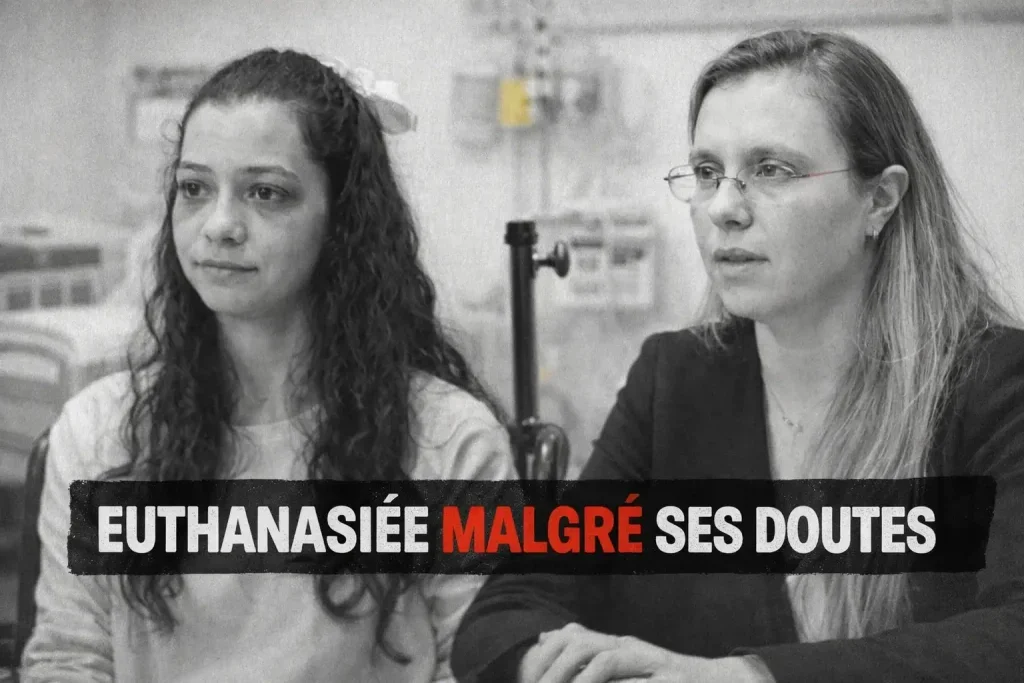
On March 26, 2026, at 6 p.m., in a Catalan care center, Noelia Castillo Ramos, 25 years old, was euthanized. Officially, she died "with dignity," in accordance with Spanish law from 2021. Unofficially, she was killed while she had, a few days earlier, written requesting a six-month reprieve to "take time to think." A request dismissed with administrative indifference: her "doubts" had, according to the authorities, "no legal value." Yet Noelia had been paraplegic since a suicide attempt in 2022, itself following sexual violence. Her psychological state, marked by proven suicidal tendencies, should have imposed a pause. Instead, the Spanish State preferred to accelerate the process.
Her organs were already promised to others before she even died…
Organs to harvest, parents to silence
According to Polonia Castellanos, lawyer for Noelia's father, the family suffered pressure not to delay the euthanasia. The reason? Medical teams had already planned organ harvesting. A macabre detail that reveals a chilling conflict of interest: in Spain, certain pro-euthanasia activists sit on both the commissions that authorize "dignified deaths" and those that manage transplantations. In other words, those who validate the suppression of one life profit from recycling its parts. Noelia herself did not even have the right to die in peace: her organs were harvested immediately after her lethal injection.
600 days of judicial battle, zero chance of survival
Since 2024, Noelia had been demanding euthanasia, citing "unbearable suffering." The Catalan commission had approved her request. But her father, Gerónimo Castillo, supported by the Abogados Cristianos association, fought relentlessly for over 600 days. Appeal after appeal, rejection after rejection – including by the Supreme Court and, it seems, by the European Court of Human Rights. Noelia, confined to a specialized center, had demanded to die alone, away from her parents. A final act of revolt, or the culmination of a system that isolates the most vulnerable before eliminating them?
The hypocrisy of a system that kills in the name of compassion
Grégor Puppinck, director of the European Centre for Law and Justice (ECLJ), who relayed the case, poses a chilling question: "What good are judges if, faced with programmed death, they cannot even impose a period of reflection?" Spain, a pioneer of legal euthanasia, today offers the spectacle of a bureaucracy where life is negotiated like an administrative file. Legal "safeguards"? An illusion. "Unbearable suffering"? A convenient argument to justify the irreversible.
Worse still: Noelia's defenders brandish her "right to die" as a victory. But what remains of humanity when a young woman in psychological distress is euthanized against her own hesitations, under the pretext that the law permits it? When her organs become, before even her death, a resource to be optimized?
France lying in wait
As France prepares to adopt its own law on "aid in dying," the Noelia case should serve as a warning. Will the "guarantees" promised hold up against the relentless logic of medical protocols and transplant needs? Puppinck recalls it with bitterness: "This is not the first time Europe has slipped toward inhumanity in the name of progress."
Noelia Castillo Ramos did not get her six months of respite. She did not even have the right to doubt until the end. Her story, now, faces us all: how far are we willing to go to transform death into a public service?
by Yoann