
London, 1939—Shortly before the beginning of World War II, the British government launched Operation Pied Piper, a voluntary evacuation of over 1 million London children in order to protect them from the impending bombing campaign by the German Luftwaffe. The children were loaded on to trains, boats, and buses and sent to safer rural areas in Britain and overseas. Each child carried a small suitcase, and around his neck a cardboard box with a gas mask, and their name was pinned on the lapel of their coat.
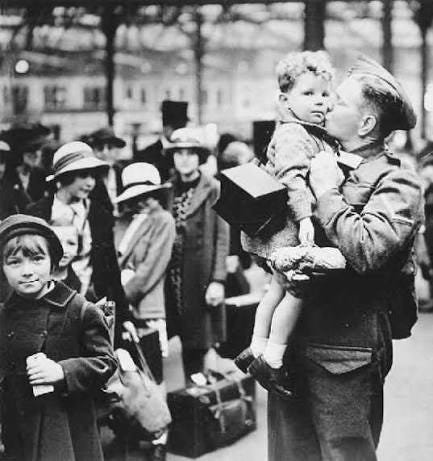
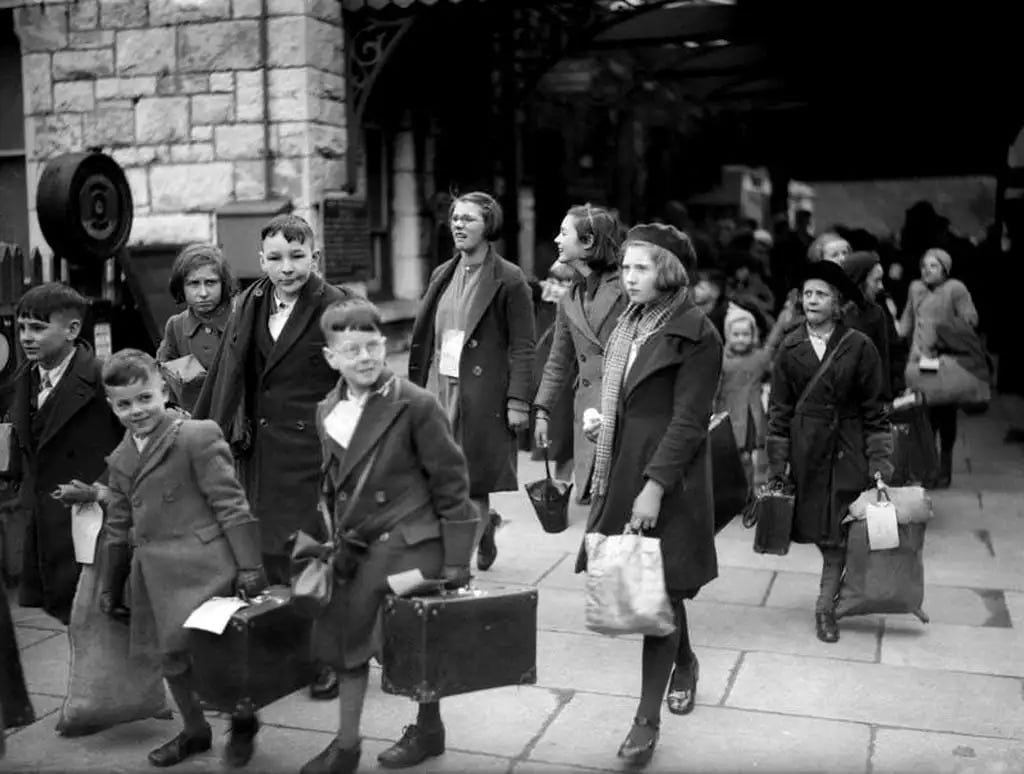
Operation Pied Piper
Their parents stayed behind in London fighting in the war effort. The heartbreaking separation of these children from their homes and families deeply traumatized the children who were cared for by host families in the rural areas during the course of the war.
The cautionary evacuation proved providential since the catastrophic German Blitz killed 43,000 Londoners and destroyed more than 66,000 houses. The German pilots flew some 571 sorties over London, dropping 711 tons of high explosive bombs on London. The German Blitz lasted 57 consecutive nights with the most devastating raid on the night of May 10-11, 1941 resulting in 1436 deaths and widespread fires that further devastated London.
The great American CBS radio War Correspondent, Edward R. Murrow was assigned to London to report on the war. Murrow broadcasted daily and live from his London radio studio with vivid accounts of the war’s devastation, informing Americans of the human toll in the streets of London. Morrow personally experienced the devastation of the bombing since his three successive radio studios were destroyed by German bombs. Nevertheless, Murrow carried on with his moving war commentary. With a smart eye for detail, Murrow’s stirring human interest stories captured the hearts and imagination of his American radio audience.
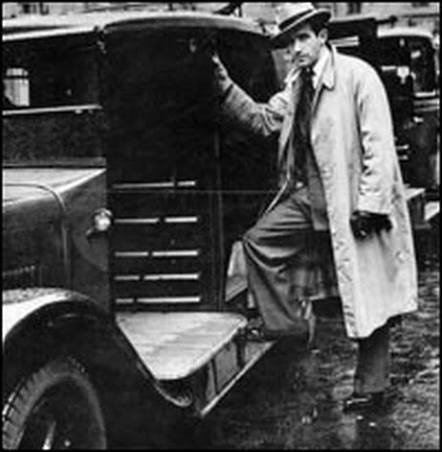
CBS Radio War Correspondent Edward R. Murrow in London
Early in the war, Murrow was suddenly struck by a very eerie scene in London following the evacuation of children during Operation Pied Piper. He poignantly captured the emptiness of a London without children:
“I neglected to tell you one thing about London. As a matter of fact, this particular aspect of the war didn’t hit me with full force until this afternoon. It’s dull in London now that the children are gone. For six days I’ve not heard a child’s voice. And that’s a strange feeling. No youngster shouting their way home from school. One needs the eloquence of the ancients to convey the full meaning of it.
There just aren’t any more children.”
~Edward R. Murrow, 1939
Murrow’s haunting words should give modernity pause: “The children are gone and I’ve not heard a child’s voice-there just aren’t any more children.” Even the eloquent wordsmith, Edward Murrow could not capture the haunting silence, the lifelessness, the dreariness, the darkness of a city without children. He longed for the cheerful air of children’s laughter filling the streets. Murrow understood that nothing could replace the joyful and boisterous presence of children.
Ironically, he could hear the silence of one million children who were gone from London. The man who was never at a loss for words, was unable to capture this bereft feeling. As Murrow searched for consolation, he could only hope that the ancient sages could make sense of it-that the ancient masters could find the words for the silence-the loss of the children.
Nearly a century later, this heartbreaking event prompts this question:
Does America even stop to notice the permanent silence of 1.2 million children aborted in 2025?
This past month a staggering news item dropped with barely a ripple. In 2025 alone, 1,129,000 abortions were performed in America-more than a million unborn lives ended in a single year. Shockingly, this figure is largely unchanged from 2024. There has been a 21% increase in abortions since 2020. How did this immense number become so easy to ignore? Statistically, it’s 2,700x the number of people who died in the September 11 attacks.
The number is almost incomprehensible. Over one million is roughly the population of a major American city such as San Diego or Dallas.
Imagine, for a moment that either city were suddenly obliterated by an act of terrorism or a catastrophic natural disaster. Imagine waking up tomorrow to find that an entire American city had been exterminated. No streets. No schools. No playgrounds. No children running through them. No families returning home. No voices. No future birthdays. Imagine the shock if terrorism or some unimaginable act of nature had emptied an American city of more than a million people. Surely, the country would notice.
The country would stop in its tracks. The screeching headlines would dominate the news. Flags would fly at half staff. Bells would toll. Politicians would speak. Families would grieve. The world would demand answers. The devastation would be remembered for generations.
Yet more than a million unborn lives can be lost in a single year—and the nation barely pauses-not even stopping to ponder the unimaginable- the violent last struggling gasps of air of these children.
Perhaps the most unsettling part is not the size of the number but how quietly we have learned to say it and watch it pass barely noticed, let alone objected to. And the statistic is the same for 2024! In two years, over 2 million babies aborted.
Two million lives. Gone. Unlike Edward R.Murrow, we don’t even stop to notice.
At the very least, the statistic should momentarily take our breath away—after all its victims are intentionally and brutally and permanently deprived of life and breath. And if for some fluke they survive, they are left to die alone on a metal table, or tossed in a receptacle as they take their last breath.
Abortion has hardened our hearts, calloused our souls, and opened up a window to the depth of depravity of our country.
Hillary Clinton’s hackneyed faux meme that “Abortion should be safe, legal and rare”, was quickly replaced with slogans justifying and de-stigmatizing abortion, even celebrating abortion:
“I’m proud of my abortion”—“Shout your abortion”— “No Shame, no stigma, just healthcare”, —”I’m not sorry for my abortion.”
The inevitable slippery slope of expanded abortion rights has reached a new precipice in Massachusetts, which joins 10 other states. No excuses needed, no longer rare, no cutoffs, just a cold blooded statutory right to end a child’s life up to the moment of birth.
Under the hideously euphemistic title, “Prioritizing Patient Access to Care Act” the law removes the specific categories and “gestational limits” after 24 weeks. Standing behind a podium with the sign (another euphemistic meme:) Abortion is Health Care-a statutory right embedded into law giving women the right to end the life of their fully formed, healthy unborn baby—ready to be born and ready to take its first breath.
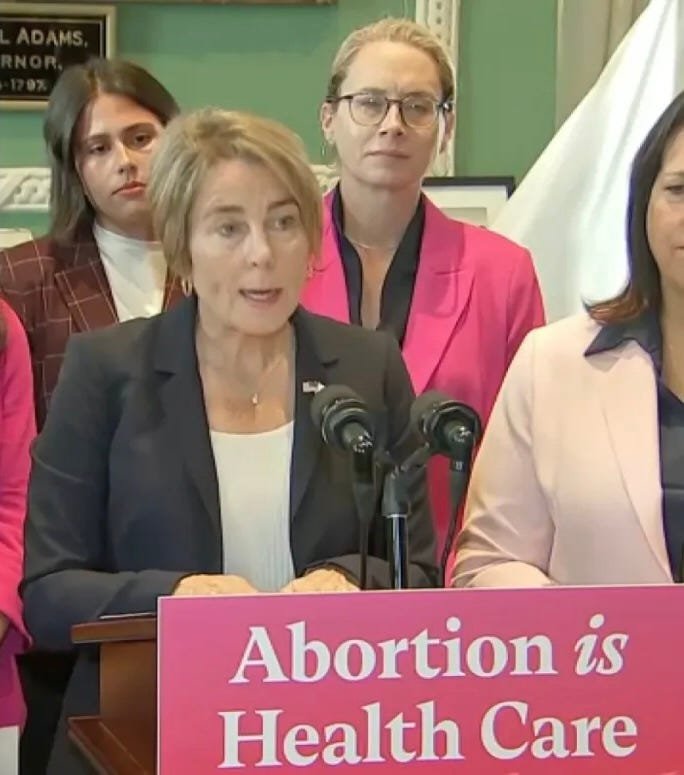
The statutory guardrails have been stripped away. The law instead places the decision in the hands of the physician’s professional judgment. That is a profound change in the law’s approach to late-term abortion: the legislature has removed the specific statutory criteria and substituted a broad professional judgment standard. The language is clinical but the implications are anything but.
The question left hanging is stark: when the law removes the boundary, what boundary even remains?
The answer appeared quickly. No boundary remains for the protection of children whose mothers seek to end their lives. The same women celebrating abortion up to birth are now vociferously supporting a mother who strangled her three toddlers with an exercise band. Squeezing tight as they gasped for air, struggled for a breath, all the time looking into the eyes of their mother.
A society cannot remove moral boundaries in one arena and then be surprised when the meaning of responsibility becomes contested in another. If professional judgment, mental illness, and personal circumstances can redefine the limits of accountability, then the question is not merely where the law draws the line. It is whether the law still believes there is even a line to draw.
A society that repeatedly calls and legislates for the destruction of unborn children as “health care” it should not be surprised when its moral vocabulary begins to fail elsewhere. Once compassion is detached from truth, and autonomy is elevated above the value of human life, even the most obvious boundaries become negotiable.
The question is not merely where the law draws the line. It is whether our consciences still recognize that a line exists--and whether we can still call the killing of children wrong when the child is inconvenient, vulnerable, or hidden from view.
Abortion is now proudly shouted from the rooftops, embedded as an essential tenet of the Democratic Party platform and in state laws. 10 states enshrine abortion of an unborn child up to birth and celebrating women surround a female governor who proudly executes (pun intended) the bill into law. Their loud and proud voices drown out the cries of the babies in the abortion killing fields.
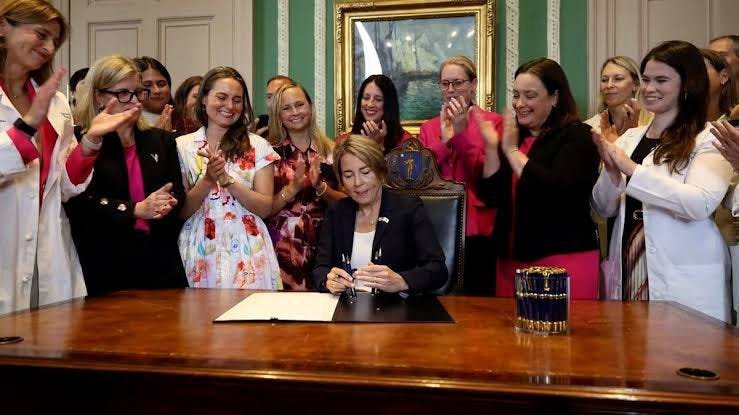
Abortion deadened us. But even more. Abortion robbed our civilization of its future, its conscience, its humanity. A society without children.
Edward R. Murrow broadcasting from London to America, tried to make his listeners understand what the numbers could not. He described the chilling absence of children and confessed that the reality of war had struck him with a new force:
“There just aren’t any children.”
It was a simple observation, but it carried the weight of a civilization suddenly confronted with what it meant for its children to disappear. Murrow understood that the absence of children could be heard. He noticed it in the silence.
Nearly a century later, America has become adept at not hearing. When America’s unborn children disappear by the millions, modernity has largely trained itself not to hear the silence at all.
There is no sudden silence in the streets. No empty classroom confronting the nation with what is missing. No morning broadcasts lingering over the absence. No collective pause at the loss of millions of children.
When London’s children were evacuated, their absence was so palpable that Murrow could hear it. He seemed to sense the essence of children described by one of Britain’s most renowned author and philosopher, G.K. Chesterton, who profoundly observed “that the humorous look of children is perhaps the most endearing of all the bonds that hold the Cosmos together.”
Chesterton’s insight is more than a sentimental observation; it is a civilizational warning: if children are among the bonds holding the cosmos together, then a culture that devalues children is not merely losing something precious-it is loosening its own bonds to reality, significance, and the future.
Chesterton understood what modern society has forgotten: the laughter and wonder of a child are not trivial things. They are among the most endearing of all human bonds. Even in the chaos of war, Edward Murrow recognized it as well. To treat children as burdens, inconveniences, or disposable lives is therefore more than a moral failure. It is an assault on the very bonds that hold us together. What happens when a civilization no longer hears the laughter of its children—-or worse, no longer recognizes their presence as a gift?
When America’s unborn children disappear by the millions, modernity has largely trained itself not to hear the silence at all.
What happens to a civilization when there are millions of children missing—and almost no one stops to notice? Chesterton knew. We are left with a handful of children begging to be born:
I think that if they gave me leave
Within the world to stand,
I would be good through all the day
I spent in fairyland.
They should not hear a word from me
Of selfishness or scorn,
If only I could find the door,
If only I were born.
~The Babe Unborn, G.K.Chesterton