
Cardinal Caffarra wrote a letter to Lucia of Fatima only to ask her to pray for the newly established Pontifical John Paul II Institute for Studies on Marriage and Family, which the Polish pope had consecrated to Our Lady of Fatima. To the cardinal’s great surprise, he received a reply from the Portuguese mystic, who wrote, among other things: “There will come a time when the decisive clash between Satan and the Kingdom of Christ will take place over marriage and the family; those who defend marriage and the family will face great persecution; but they should not be afraid, for Our Lady has already crushed his head.”
This preface, coming directly from Heaven, serves as an introduction to the subject that follows.
A master of deceit, Francis did not explicitly write in his apostolic exhortation (with lowercase initials), Amoris laetitia, that it would be permissible to give Communion to divorced and remarried people, but he strongly implied it. Faced with this Bergoglian subterfuge, the Argentine bishops expressed doubts and asked whether their interpretation concerning the divorced and remarried was permissible: “Amoris laetitia opens up the possibility of access to the Sacraments of Reconciliation and the Eucharist (cf. notes 336 and 351).” Bergoglio promptly replied in a letter that same day: “The text is very good and explains Chapter VIII of Amoris laetitia excellently. There is no other interpretation. I am sure it will do a great deal of good.”
Archbishop Bruno Forte is a theologian whom Bergoglio greatly admired, to the point of appointing him special secretary of the Synod on the Family. But one day he unmasked Francis, reporting his words: “If we speak explicitly about giving Communion to the divorced and remarried, you have no idea what a mess they’ll make of it. So let’s not talk about it directly; make sure the groundwork is there, and then I’ll draw the conclusions.” Forte’s comment—“Typical of a Jesuit”—sent the man who was abusively occupying the Chair of Peter into a rage.
But that is not all! To grasp the extent of the Argentine’s dishonesty, I’ll recount another revealing episode. On the return flight from Lesbos, a journalist asked: “It wasn’t clear why you wrote that famous note in Amoris laetitia about the problems of the divorced and remarried, note 351. Why put something so important in a small note? Did you anticipate opposition, or did you mean to say that this point wasn’t so important?” Serving Satan can also lead to awkward moments, and after uttering remarks that were completely beside the point, Bergoglio replied: “I don’t remember that note, but surely, if something like that is in a footnote, it’s because it was said, I think, in Evangelii gaudium. Certainly! It must be a quotation from Evangelii gaudium. But I don’t remember the number—certainly.”
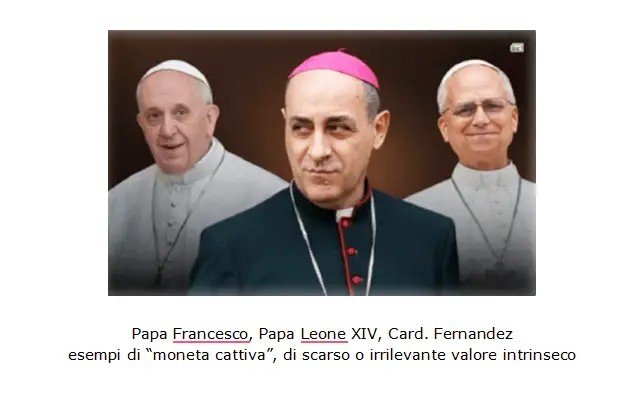
Leo XIV could do nothing but extol the heresy of his guiding spirit. In a solemn message dated March 19, he wrote: “On March 19, 2016, Pope Francis offered the universal Church a luminous message of hope concerning conjugal and family love: the Apostolic Exhortation Amoris laetitia, the fruit of three years of synodal discernment.” With spectacular intellectual and spiritual dishonesty, Leo juxtaposed Amoris laetitia with John Paul II’s exhortation Familiaris consortio, which, by contrast, categorically bars divorced and remarried people from receiving Communion: “The Church, however, reaffirms her practice, which is based upon Sacred Scripture, of not admitting to Eucharistic Communion divorced persons who have remarried” (84). On the same occasion, Prevost added: “I have decided to convene, in October 2026, the presidents of episcopal conferences from around the world, in order to pursue, through mutual listening, a synodal discernment on the steps to be taken to proclaim the Gospel to families today, in the light of Amoris laetitia and taking into account what is being done in the local Churches.” Note carefully that the plural “families today” alludes to every kind of cohabitation. In his October 7 address, Prevost used the word “families” fourteen times.
When the celebrated duo “Ciccio & Tucho” were already planning Fiducia Supplicans, paragraph 297 of Amoris laetitia stated: “It is a matter of integrating everyone […] No one can be condemned for ever, because that is not the logic of the Gospel! I am referring not only to the divorced and remarried, but to everyone, in whatever situation they find themselves.” In keeping with this paragraph—which, by “whatever situation they find themselves,” implicitly includes same-sex couples—Bishop Heiner Wilmer, president of the German Bishops’ Conference, promised to bring gay couples to the gathering as a way of affirming the nobility of same-sex marriage.
On October 2, a press conference was held to present the gathering Leo had scheduled for October 7–14, “Ten Years after Amoris laetitia: Proclaiming the Gospel with Families Today.” One of the speakers was Father Giacomo Costa, who said: “In the working groups, we will use Conversation in the Spirit, alternating speaking, listening and silence… This is not a new final document to replace the apostolic exhortation, but a report back on what the Assembly has recognized through listening and discernment.” This language—by now thoroughly stale—did not bode well. Indeed, Leo XIV invited to the gathering prominent figures from the LGBT agenda, including Fernández, Cupich, McElroy, Tobin, Cobo, Hollerich and Tagle, while excluding all those who had opposed the heretical document. Given this background, which made Prevost’s intentions quite clear, it is obvious that Conversation in the Spirit, held strictly behind closed doors so as not to cause too much scandal, would take place only among like-minded people, thereby ensuring the triumph of listening and discernment.
It is worth noting that while Leo had ordered the gathering to be tightly sealed so that nothing too embarrassing would get out, on the 8th, at the opening of the academic year of the pontifical universities, he said: “Dear friends, value study as a service to faith and truth… cultivate friendship, a precious gift, all the more when it is lived through the shared search for truth in Christ… let us open the door, not shut ourselves in… do not limit yourselves to sitting beside one another: meet, talk, listen to one another, share your experiences of the Church.” This is the measure of Leo XIV’s consistency: he constantly speaks of “truth” and “listening,” then does the exact opposite… but few people notice.
Prevost’s opening address on the 7th already made the event’s foregone conclusion apparent: the word “sin” was absent, and the entire speech revolved around the idol of Fragility, capable of justifying Everything:
“Amoris laetitia has given rise to ‘stories of conversion, unexpected fruits and relationships that God has woven within families.’ Listening and guided by the Holy Spirit, we face the ‘experience of fragility,’ marked by ‘limitations, wounds and apparent failures.’ Attentive to the promptings of the Holy Spirit… I ask the Lord to help us gather the fruits that Amoris laetitia has borne in our local Churches, so that they may nourish the whole Church.”
I am not surprised by these misleading statements, which are nothing new, but by the audacity to make them shamelessly and without any fear of God!
After Leo, Sister Helen Alford, president of the Pontifical Academy of Social Sciences, spoke and reassured the participants, claiming that Amoris laetitia is in continuity with the Church’s previous doctrine and practice. During his address on October 8, Cardinal Filipe Neri Ferrão, archbishop of Goa and Daman and president of the Federation of Asian Bishops’ Conferences, said that the Church should be ready to welcome “new forms of union and cohabitation,” rather than insist on a model of the “ideal family.” He added that instead of insisting on unchanging moral norms, the Church should welcome modern relationship models and involve them in its evangelizing mission. Professor Vincenzo Rosito, vice-dean of the Pontifical John Paul II Theological Institute for Marriage and Family Sciences, praised Amoris laetitia for allowing divorced and remarried people to receive Communion; he then invited those present to reflect on possible new ways of being a “family.”
On the 9th, Auxiliary Bishop Stephen Fernandes of Bombay urged people to look for what is good in cohabiting couples and to recognize signs of grace. Invoking the magic word “accompaniment,” the bishop cited Familiaris consortio in support of his position, forgetting that John Paul II published the exhortation in 1981, before parish priests had been contaminated and poisoned by Amoris laetitia and the prevailing LGBT ideology in the false church founded by Jorge Mario Bergoglio. The question that naturally occurs even to a Christian of average education is this: are “today’s” parish priests capable of accompanying cohabiting couples in accordance with the Gospel of Jesus Christ? That same day, the Vatican Press Office announced the retirement of Giovanni Battista Re, Dean of the College of Cardinals, who was replaced by an Amoris laetitia enthusiast of the stature of Luis Antonio G. Tagle.
At the Angelus, Leo made an announcement that TG5 described as “shocking”: he would soon be admitted to the Gemelli Hospital for a lung nodule. When has a minimally invasive surgical procedure, requiring no urgency, ever been scheduled for a pope within just a few days and during an important Church gathering? I recall Prevost’s words on the 7th: “I wanted to convene this gathering ten years after the publication of Amoris laetitia, and I thank you for rearranging your commitments so that you could spend these days together.” Given the care he showed for the Rome event, which was to conclude on the 14th with a Mass celebrated by him, this rush to undergo surgery—whatever the media may say—not only raises serious suspicions, but looks more like a forced removal. Prevost was admitted in the late morning of the 13th. What would have prevented the admission from being postponed by one day? Fearing that the celebrated luminous document might cast its gloomy shadows over the synodal Church as well, Leo ordered that the Summary Report not be made public until he had examined it himself.
To cover up Leo’s “flight,” someone ordered Rai and Mediaset to give extensive coverage to the surgery, magnifying it as much as possible with interviews with various doctors about its possible future implications and speculation about canceling the planned trip to South America.
At that point, what could anyone have expected from the briefing on the 12th? A parade of stock phrases designed to say nothing. Father Costa posed this supposedly thought-provoking question: “After ten years of Amoris laetitia, the question is: to what extent has it become part of the ordinary life of our communities, rather than something confined to a particular area? Looking back over these years allows us to recognize these fruits and these difficulties; some insights have been confirmed, while others are still waiting to become shared, ordinary practice.” Naturally, Leo’s absence required a change in attitude and language, which Costa revealed in these words: “(The hospitalization) entails changes in the way we conceive the development of our gathering,” adding: “The Holy Father wanted to listen, and then to give his own thoughts on what he had heard.”
On the evening of the 13th, the Vatican bulletin reported: “The intraoperative histological examination confirmed the diagnosis of pulmonary adenocarcinoma, as suspected from the preoperative tests.” But this result does not alter my analysis. At today’s closing Mass (the 14th), Cardinal Tagle read Leo XIV’s homily: an antiseptic, painless and cowardly text, focused entirely on charity as lived in the family, without addressing in the slightest the uproar caused by the heretical document: “This is the charity that Amoris laetitia invites us to make the foundation of our families… Thus, domestic charity is concrete, and not without moments of difficulty, mistakes and falls.” To confirm his blessing of Amoris laetitia, “Holy Father Francis” was celebrated from beginning to end of the homily—a veritable concentration of hot air.
Leo’s improvised strategy not only took the writer by surprise, but also everyone concerned with the impeded see. In the situation that has arisen, one burning question remains: did Leo choose to “defend himself” from Amoris laetitia, or was he forced by some circumstance unknown to us? The second hypothesis seems more credible to me. In any case, whatever the outcome of the urgent admission to Gemelli, this summit has canonized Amoris laetitia. What happens now? The likes of Müller, Viganò, Strickland, Schneider, Mutsaerts and their associates will continue to complain and raise troubling but futile questions, without having the courage to tell the world that Leo XIV is not the Pope, but a natural continuation of the antipope Francis. Despite these grave failures on the part of the Catholic hierarchy, I would not rule out a schism in the near future, which, however, could only bring further confusion and solve nothing. We must be certain: the ALMIGHTY will resolve everything after the “Great Purification,” which is already under way, even if we are still only at the aperitif.
We are witnessing the fulfillment of Lucia’s prophecy. The apostate and sacrilegious synodal Church has profaned the sacrament of marriage, normalized the sin of adultery, and, by blessing gay unions, elevated the sin of sodomy to a virtue. Like his predecessor, among the various offenses for which Robert Francis Prevost will have to answer before God’s tribunal will be crimes against the Sixth Commandment.