
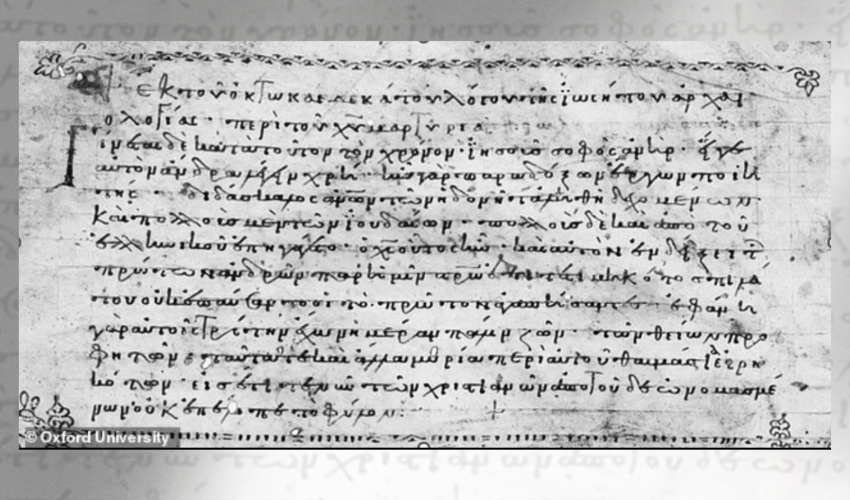
Flavius Josephus was neither an apostle nor a disciple of Christ. Born around the year 37, this Jewish historian, hailing from a priestly family in Jerusalem, participated in the political and religious life of his time before settling in Rome. Around 93–94, he completed his Antiquities of the Jews, a vast narrative in which appears a passage that has become famous under the name of the Testimonium Flavianum. The transmitted Greek text mentions Jesus, his condemnation by Pontius Pilate, and the fidelity of his disciples. But it contains above all this extraordinary affirmation: that Jesus appeared to them alive on the third day, in accordance with the prophecies.
An immediate difficulty arises. How could a Jewish historian, who had not embraced the Christian faith, have explicitly acknowledged Jesus as the Christ and affirmed his Resurrection?
It is this apparent contradiction that Jesús Fernández-Pedrera Correa seeks to clarify. In a preprint deposited on August 15, 2026, on Zenodo, he compares four traditions of transmission of the passage: Greek, Latin, Arabic, and Syriac. The versions preserved notably in the works of St. Jerome, Agapius of Hierapolis, and Michael the Syrian contain certain more cautious formulations. Whereas the Greek text affirms that Jesus « was the Christ, » other traditions indicate that he was considered as such. In the Arabic tradition, the appearance of Jesus alive after his crucifixion is reported as an affirmation of his disciples. This distinction fundamentally alters the historical significance of the testimony. Josephus would not necessarily have professed faith in the Resurrection: he may simply have reported what the first Christians proclaimed.
It would nonetheless be excessive to conclude that these later versions restore the original text with certainty. The researcher himself acknowledges the limits of this reconstruction. But another study, published in 2025 by Oxford University Press, adds another dimension to this discussion. In Josephus and Jesus: New Evidence for the One Called Christ, the American academic T. C. Schmidt defends a much more extensive authenticity of Josephus’ testimony. His analysis of vocabulary, historical circumstances, and the author’s relations with the authorities of Jerusalem leads to a particularly intriguing hypothesis: Josephus may have had access to information from men connected to the trials of the first apostles, or even to that of Jesus.
This possibility does not in any way demonstrate that he would have met direct witnesses of the Resurrection. It nonetheless invites us to reconsider the historical proximity between his account and the first Christian generations. The book has indeed sparked academic discussions, notably in the Journal of Theological Studies in 2026.
An ancient element further heightens the interest of the debate. In the 3rd century, Origen affirmed that Josephus did not acknowledge Jesus as the Christ. This observation seems difficult to reconcile with certain expressions in the Greek text transmitted today and fuels the hypothesis of later Christian interpolations.
In contrast, another reference in the Antiquities of the Jews, concerning James, « the brother of Jesus, who is called Christ, » is generally considered authentic by historians. The stakes ultimately transcend the mere critique of manuscripts. In a second study published in August 2026, Jesús Fernández-Pedrera Correa also questions the limits of a historical method that would, by principle, exclude any supernatural explanation. A legitimate philosophical inquiry, which, however, cannot serve as proof of the miracle.
For history can establish the antiquity of a proclamation, study its witnesses, and verify the transmission of texts. By these means alone, it cannot demonstrate that Christ truly emerged from the tomb. For the Church, this distinction in no way diminishes the value of research. Christianity has affirmed since its origins that the Resurrection is not merely a spiritual symbol, but a real event that occurred in history.
St. Paul wrote as much, only a few decades after the Crucifixion: « If Christ has not been raised, then our preaching is in vain and your faith is in vain » (1 Cor 15:14). Two thousand years later, the question remains as pressing for the historian as for the believer: what did Flavius Josephus truly know of this man crucified in Jerusalem, whose disciples claimed had returned to life?