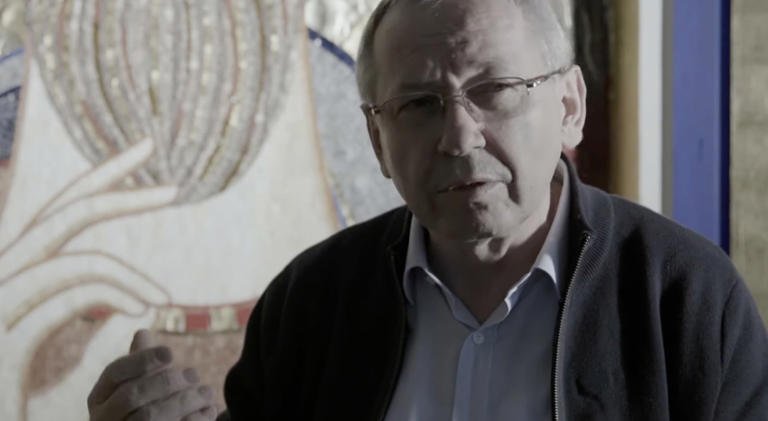
Marko Rupnik© Ap
At the Vatican, a suspicious cloak of silence has fallen over the Rupnik trial. Yet only a few months have passed since — on November 7, 2025 — Pope Leo personally made it a point to reassure world public opinion as well as the victims of the former Jesuit, accused of sexual and psychological abuse of some thirty women. The Pontiff had stepped forward to announce that the new canonical trial had finally been "initiated and judges appointed," and that patience was required. A few days later, the lawyer representing five of the victims (those who first revealed to the world cruel and most serious episodes) sent an email to the top of the Dicastery for the Doctrine of the Faith in order to obtain from Cardinal Fernandez and Msgr. Kennedy the technical and procedural clarifications necessary to understand how to proceed. "To have a minimum of clarity on the procedure, in respect and in the interest of all."
The letter signed by lawyer Laura Sgrò referred to statements made in early 2025 by Cardinal Fernandez, asserting that the Vatican had finally managed to identify the members of the College tasked with judging one of the most burning, horrific and thorny cases of recent decades. A case in which an influential and famous artist sits in the dock, Father Rupnik, accused of repeated abuse. So far, he appears to have always managed to escape the meshes of canonical justice thanks to his powerful friendships, his ties with influential cardinals and even with two pontiffs, Saint John Paul II and Pope Francis. The latter — who kept one of his paintings in his room — is said to have personally annulled in 2020 the excommunication pronounced by the Dicastery for the Doctrine of the Faith. A case that has fueled many questions, highlighting a lack of transparency.
Seeing time pass without any news, the lawyer attempted repeatedly to obtain answers from the Vatican Dicastery, but always without result. "I have solicited the Dicastery for the Doctrine of the Faith repeatedly to obtain information. The victims have no idea what is happening." To this day, "we know neither the number nor the names of those who are part of the judgment college." "No one has ever officially given us news. The victims are already paying a very high price for many years, a price that, instead of diminishing, continues to grow. And this is not only intolerable, but also contrary to all legal principle. For if it is right that there be a fair trial where all rights are guaranteed, first and foremost the principle of innocence and defense of Marko Rupnik, it is equally right that there be a time frame within which all this must take place, the time of fair trial, so that the victims can then find oblivion. All this, unfortunately, and I say it with immense regret..."
Once again, the Vatican's modus operandi in matters of justice seems characterized by a lack of transparency, as associations fighting for the defense of sexual abuse victims have always pointed out in recent years. Across the Tiber, evoking the Rupnik case always elicits the same reaction: embarrassment and irritation. The rare information on the judgment college had been provided by Cardinal Fernandez last year, asserting only that it was composed of women and clergy, but without specifying their names, their respective competencies, their curricula or their nationalities. In the meantime, the curtain has fallen on the case, much to the dismay of the victims.
In parallel, a fierce struggle continues within the Church over the future of Rupnik's works present in sanctuaries, churches and basilicas. Many bishops are wondering whether they should be dismantled or maintained in the most prestigious places of worship in the world. At Lourdes, the Bishop has already chosen to hide the large mosaics because, he explained, they only added anguish to abuse victims coming to the sanctuary to find peace and reconcile with the Church. In Rome, on the other hand, where Rupnik has oddly continued to enjoy particular goodwill, no one wants to talk about his works. So much so that at the Vicariate, no one has ever raised the problem of the very costly chapel created at the time of Cardinal Angelo De Donatis, current penitentiary (and great protector of the alleged perpetrator). Pope Leo, during the spiritual exercises of the curia, wanted to send a message by avoiding holding the exercises in the chapel of the apostolic palace containing the mosaics created at the time of John Paul II. Instead of listening to sermons in the Redemptoris Mater Chapel, he chose the Pauline Chapel. However, the Vatican never wanted to explain the reason for this choice. Opacity reigns, as always, as master.
Last year, the Society of Jesus, in the person of the Delegate General, Father Johan Verschueren, had authored a genuine mea culpa. He had asked for forgiveness from the victims to begin with them a path of reparation, "oriented towards the healing of wounds" caused by "the acts of Marko Rupnik." The Jesuits had offered Marko Rupnik the possibility of publicly assuming his actions, repenting, asking forgiveness and beginning a therapeutic path. Following his persistent refusal to submit to this possibility, the Father General made the decision to dismiss him.
To date, there are some thirty complaints from abused religious women, over a period spanning the 1980s to the present. Father Arturo Sosa, Superior General of the Society of Jesus, had declared: "We asked forgiveness for our blindness. We did not see, it is true. Where does this blindness come from? From the fact of not having gathered the signs that existed. Moreover, in the past, it was not easy to lodge such a complaint. And we lacked the sensitivity to see what had happened."