The retired archbishop of La Plata, in Argentina, has left a column for the American blog Rorate Coeli. In it he expresses his admiration for the renewal of Tradition and reiterates the thesis affirming that Archbishop Annibale Bugnini, central figure of post-Vatican II liturgical reforms, was a Freemason.
A youth drawn to Tradition and the Tridentine Mass
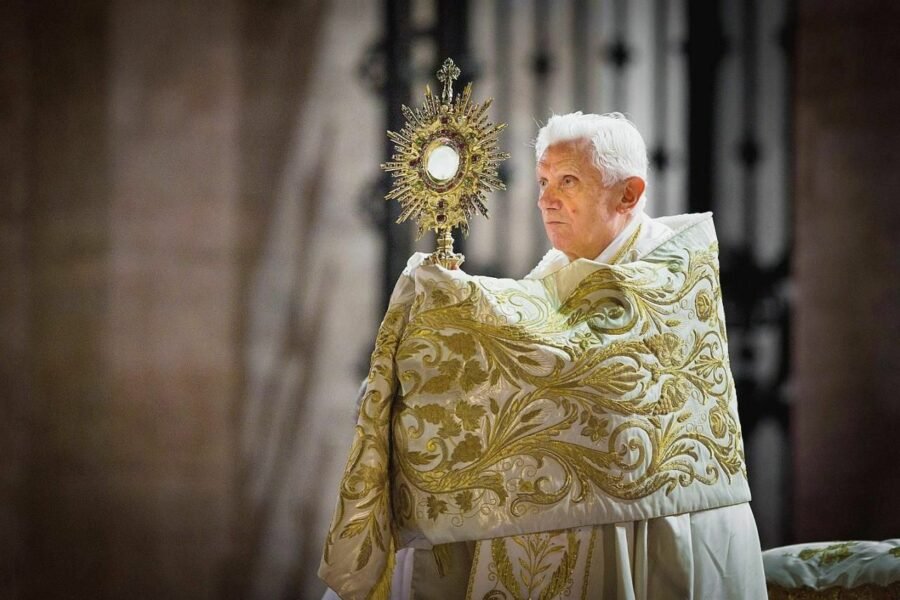
In a lengthy column published on the blog Rorate Coeli, the retired archbishop of La Plata, in Argentina, Hector Agüer expresses his admiration for a youth drawn to Tradition and the Tridentine Mass. He welcomes this « renewal of Catholic tradition, stifled in these countries by liberalism, progressivism and atheism », visible notably during the « traditional pilgrimage Paris-Chartres », he notes.
From reading his text, one understands that the archbishop, who is nonetheless attached to the Montinian rite, acknowledges some interesting reservations regarding it as they coincide, in part, with those formulated in the opus Brief Critical Examination of the New Ordo Missae, by Cardinals Alfredo Ottaviani and Antonio Bacci, and by Mgr Lefebvre.
« Under the pontificate of Paul VI (Giovanni Battista Montini), who succeeded the brief pontificate of John XXIII (who had convened the ecumenical council), a new Mass, writes Mgr Agüer, was instituted. A few modifications could have been made to the « traditional Mass », as had been the case over the centuries of its existence. But no; Vatican II wished to rework everything, and a new Mass was meant to be born from its spirit. Always valid, certainly; but not without ambiguities left to the appreciation of celebrants. »
Archbishop Annibale Bugnini, a Freemason recognized by irrefutable documents
And he continues by reiterating the thesis affirming that Archbishop Annibale Bugnini, central figure of the post-Vatican II liturgical reforms, was a Freemason:
« The author of the new Mass was Archbishop Annibale Bugnini, a Freemason recognized by irrefutable documents, although his membership in Freemasonry remained secret, in keeping with the very nature of this order. »
Such an accusation against the architect of the new Mass, Annibale Bugnini, is not new, but coming from an emeritus bishop of the official Church, it acquires a broader reach beyond the circles of Tradition alone. If it was indeed a Freemason, that is, a clergyman ipso-facto excommunicated for membership in an occult sect, who 'invented' the Ordo Missae of Paul VI, should we then be surprised by all the ambiguities it carries, the loss of faith it entails, the 'Masses' that are improper, indecent, even blasphemous and sacrilegious, which it gives rise to in so many parishes?
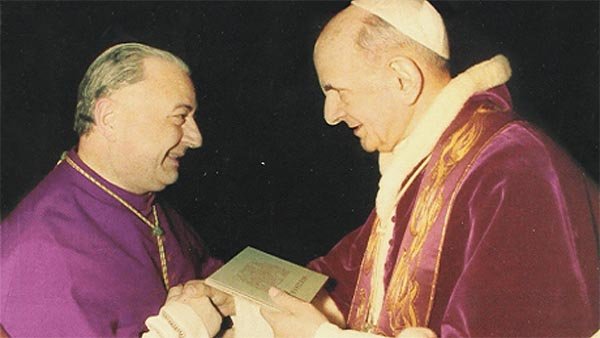
An exceptional collaborator of Pope Paul VI for twelve years, Bugnini was brutally removed from his position in 1975
Rumors of Annibale Bugnini's membership in Freemasonry were fueled by his disgrace in 1975. Joseph Shaw, of the Latin Mass Society, recalls in an article:
« An exceptional collaborator of Pope Paul VI for twelve years, he was brutally removed from his position (following the merger of two departments of the Curia) and appointed apostolic nuncio to Uruguay. Bugnini protested, arguing his lack of training and diplomatic experience, his ignorance of Spanish, and desperately seeking to understand what had happened. Pope Paul VI refused to answer his messages and offered him the position of nuncio to Iran. He felt compelled to accept this assignment in January 1976.
« The idea that Bugnini had been reported to Pope Paul VI as a Freemason spread sufficiently that, apparently with some reluctance, Bugnini himself felt obliged to deny his membership in Freemasonry, not only in private but also in public. This seemed to be confirmed when a list of alleged members of « Propaganda Due », « P2 », a notorious Italian Masonic lodge, appeared publicly in 1981, with Bugnini's name on that list.
Bugnini's fall remains a mystery
« Bugnini's fall remains a mystery requiring explanation, and it is in this legal void that the famous « briefcase story » was born. According to this version, Bugnini's fate would have been sealed by the fact that he allegedly left a briefcase in a Roman meeting room. When it was opened to discover the identity of its owner, documents were found implicating him as a Freemason.
« This story has been corroborated by various people, in private and sometimes in public, who claimed it came from above-reproach personalities, who nevertheless wished to remain anonymous. Given the polarization of opinions concerning Annibale Bugnini, this situation allowed both his friends and his enemies to believe exactly what they wanted.
« Kevin Symonds has now been able to trace this story to its source. Father Brian Harrison, whose 1989 published account is authoritative on the matter, revealed to Symonds who transmitted the information and which cardinal took charge of the briefcase, first submitting it to the police for verification, then to Pope Paul VI, threatening to make it public if the latter did not take action.
Details transform the rumor about Bugnini's membership in Freemasonry into a serious historical assertion
« This is not speculation: Father Harrison now feels able to reveal what he heard thirty years ago, since the men involved have passed away.
« Certainly, these new details do not establish Bugnini's membership in Freemasonry irrefutably, but they transform an unexplained rumor into a serious historical assertion. »
A book published in 2019 by Taylor Marshall, Infiltration: The Plot to Destroy the Church from Within (Manchester, New Hampshire: Sophia Institute Press, 2019), traces Annibale Bugnini's influence in the Montinian liturgical reform and the assertion of his membership in Freemasonry.
Thus, from one Hannibal to another, it was no longer Hannibal the Carthaginian and his elephants who made Rome tremble, but twenty-two centuries later, Annibal the Mason and his sectarian accomplices who tore to pieces the Holy Sacrifice of the Mass!
Francesca de Villasmundo