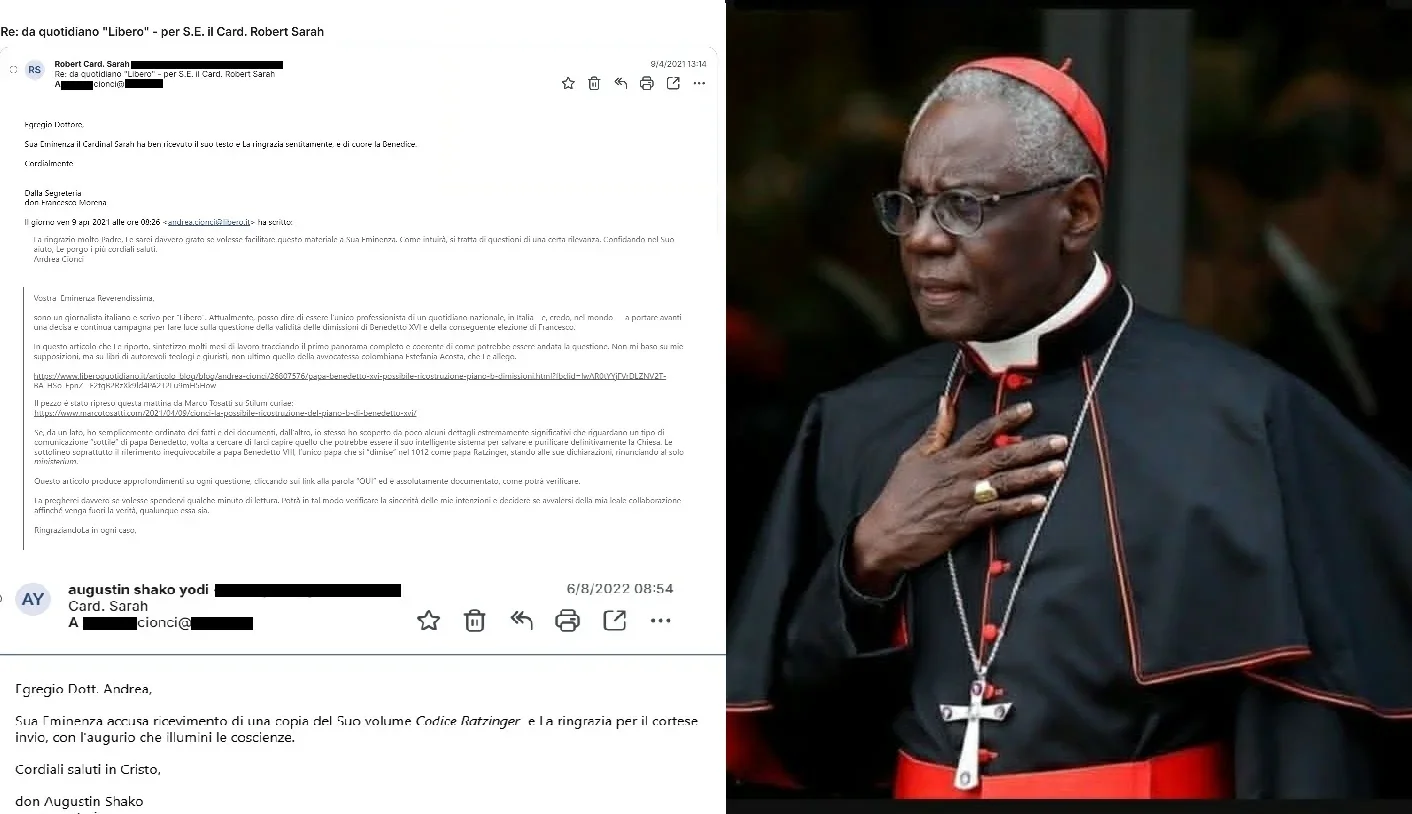
John‑Henry Westen: There’s been a lot of talk recently ever since we broke the news that the Vatican criminal court is indeed looking into the petition of Andrea Cionci, the well‑known Italian reporter who’s been doggedly investigating Benedict’s resignation. Is it real? Did it satisfy the requirements of canon law? That is actually being considered at the Vatican criminal court.
What happens if a pope were to become a heretic? Pope Innocent III says very clearly that if the Pope were to become a heretic, he would lose office — he is to be cast out and trampled underfoot by men.
Fr. Paul Kramer: Thank you very much for having me. I hope I can shed some light on this topic. For most people approaching the issue, it’s confusing if they’re laymen without formation in this area. Let me begin with Benedict’s resignation and explain why some maintain it was invalid.
Many who have written or spoken on this have ecclesiastical degrees in canon law or theology, but their opinions often fail to reflect the Church’s canonical and doctrinal mind. They miss important distinctions. Some say Benedict intended to relinquish the office and therefore his renunciation was valid. But when you examine the question from the perspective of canon law and theology, you don’t ask what he intended subjectively; you ask what the formal object of his act was. In other words: what did he actually express in his declaration of renunciation? Did he renounce the munus (the office) or did he renounce only the ministerium (the active exercise of the ministry)?
Canon 332 (if I recall correctly) states that if a pope resigns, he must resign the munus. Yet Benedict’s declaration explicitly says he is not renouncing the munus; he speaks of relinquishing the exercise of the ministry. To my mind, that is a contradiction: if a man resigns, he must resign the munus, but Benedict said he was not resigning the munus — therefore, whatever he did, he did not resign the papacy. That is the enigma that may be explained by the “secret,” and people have a right to ask for that secret and the rest of the relevant texts.
Many commentators claim Benedict used the words ministerium and munus interchangeably, or that he implicitly intended to renounce the munus even if he didn’t use those exact words. I contend this is incorrect. When you parse Benedict’s declaration — especially in the Latin — it is clear he intended to renounce the exercise of the ministry while maintaining the munus in a passive, spiritual sense. Years later he explicitly stated his munus remained, that what remained for him was a spiritual mandate. Thus, until the end he maintained that aspect of the munus.
A valid papal renunciation cannot occur unless the pope totally renounces the munus. Benedict’s formulation, in effect, created a situation analogous to a bishop who resigns jurisdiction and becomes bishop emeritus: he relinquishes governance but retains the title and a passive aspect. Pope Benedict modeled resignation of the pope on resignation of a diocesan bishop — but that analogy fails because the Petrine munus is singular and indivisible: it inheres in one person. The loss of office requires an explicit renunciation of the munus itself.
Historically and doctrinally, the munus is singular and belongs to one person alone. A man loses that munus only by death or by voluntary renunciation. If Benedict retained the munus in any form, then his act did not effect the loss of the pontificate.
John‑Henry Westen: You spoke about later explanations Benedict gave. What did he say when asked explicitly, for example about the confusion created by Amoris laetitia and comments by Cardinal Burke?
Fr. Kramer: When asked by journalists, Benedict replied that he would not take a direct position on questions of governance because that would interfere with the governance of the Church; his munus, he said, remained the spiritual dimension. He described that spiritual mandate — in Latin, the munus — as still belonging to him. That confirms his view that he retained the munus in a spiritual, passive way.
Because of that, Benedict’s declaration is not sufficient to validly renounce the office. Many commentators overlook the formal object of his act and improperly treat “resignation” as if it were merely a renunciation of active governance.
John‑Henry Westen: If a pope does not validly renounce the munus but only the ministerium, what follows for Francis and now for Leo? How does that play out?
Fr. Kramer: There are several canonical and theological consequences. Church teaching and canon law distinguish between those suspected of heresy and those manifestly and obviously formal heretics. For suspected heretics, ecclesiastical admonitions and canonical processes apply. For manifest, public heretics, the penalty can be automatic excommunication and automatic loss of office; this loss does not depend on a judgment pronounced by the Church — it happens by the fact of the heresy itself, and the ecclesiastical judgment only confirms what has already occurred.
Pope Innocent III taught about this: if a pope becomes a heretic, he loses his office. The heretic is outside the Church; he becomes lower than any Catholic in rank. This is reflected in historical cases treated by councils regarding antipopes. Thus, if Benedict’s renunciation was not valid and the man who claims the papacy — Jorge Bergoglio — is a public heretic, then he would be incapable of the office. Canonical and theological tradition says a notoriously heretical pope loses the ability to hold the Petrine office.
I have treated these topics at length in my books. I explain why Benedict did not validly renounce the office and why Francis, even if universally accepted in some sense, could be incapable of the papacy if he is a manifest heretic.
John‑Henry Westen: Can you explain how theologians determine manifest heresy and what makes a person incapable of the papacy?
Fr. Kramer: Canonists and theologians distinguish degrees of heresy. For penal processes concerning suspected heretics, canonical warnings are given by the superior to the subject. But when someone is a public, manifest heretic, they incur automatic penalties, including loss of office. The Council of Constance, addressing antipopes, pointed out that because of schism and heresy a person could have lost office by the fact of his error.
A person becomes incapable of being pope if his very person is opposed to the faith. St. Robert Bellarmine and other doctors explain that a heretical man is an unsuitable subject for the papacy because the papacy requires the foundation of the faith in the person of the pope. If a man opposes the faith, he cannot be that foundation.
John‑Henry Westen: If Francis were not pope, what happens at his death? What about Leo XIV?
Fr. Kramer: If Francis is not pope because he is a manifest heretic, then at his death the situation depends on the ordinary magisterium and acceptance by the Church of a subsequent election. If a later claimant were unquestionably orthodox and accepted by the whole Church, theologians hold that such universal acceptance could convalidate an elected pope even if the earlier election were invalid. In other words, an orthodox and broadly accepted successor could become pope.
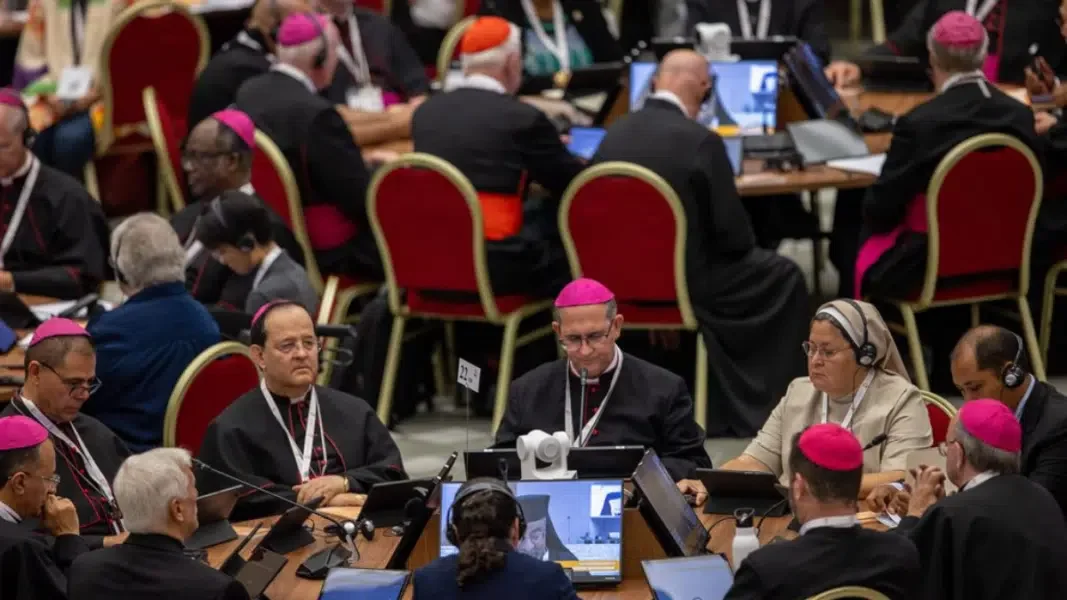
However, every indication regarding Leo is that he advocates synodality as constitutive of the Church — a “synodal church.” Synodality as the constitutive principle denies the divine constitution of the Catholic Church under the primacy of St. Peter. The Anglican model is a prototypical synodal structure: governance by councils or national hierarchies rather than a singular, supreme Petrine primacy. If Leo promotes synodality in a way that denies the full and absolute jurisdiction of the pope, that raises canonical indications of heresy. According to canonical criteria, that could make him a doubtful pope and subject to correction.
So where does that leave us? It leaves us watching to see whether Leo will be corrected and will move to clarify his positions. Will he align himself with the faith and the apostolic tradition, or will he move toward synodalism and a model of governance incompatible with the papal primacy? We must wait and see and, if necessary, seek correction.
John‑Henry Westen: Thank you very much, Father Kramer. I encourage people who want to learn more to get Father’s books.
Fr. Kramer: Thank you.