I. A DISEASE, A KING, A FORMULA
Scrofula—the popular name for chronic tuberculous cervical adenopathy—was in the Middle Ages a terribly visible affliction: suppurating lymph nodes, purulent fistulas, wounds exhaling a fetid odor. A disease of miserable bodies, resistant to all known remedies. And yet, it was precisely this disease that French royal tradition had chosen to manifest the supernatural power of its sovereigns.
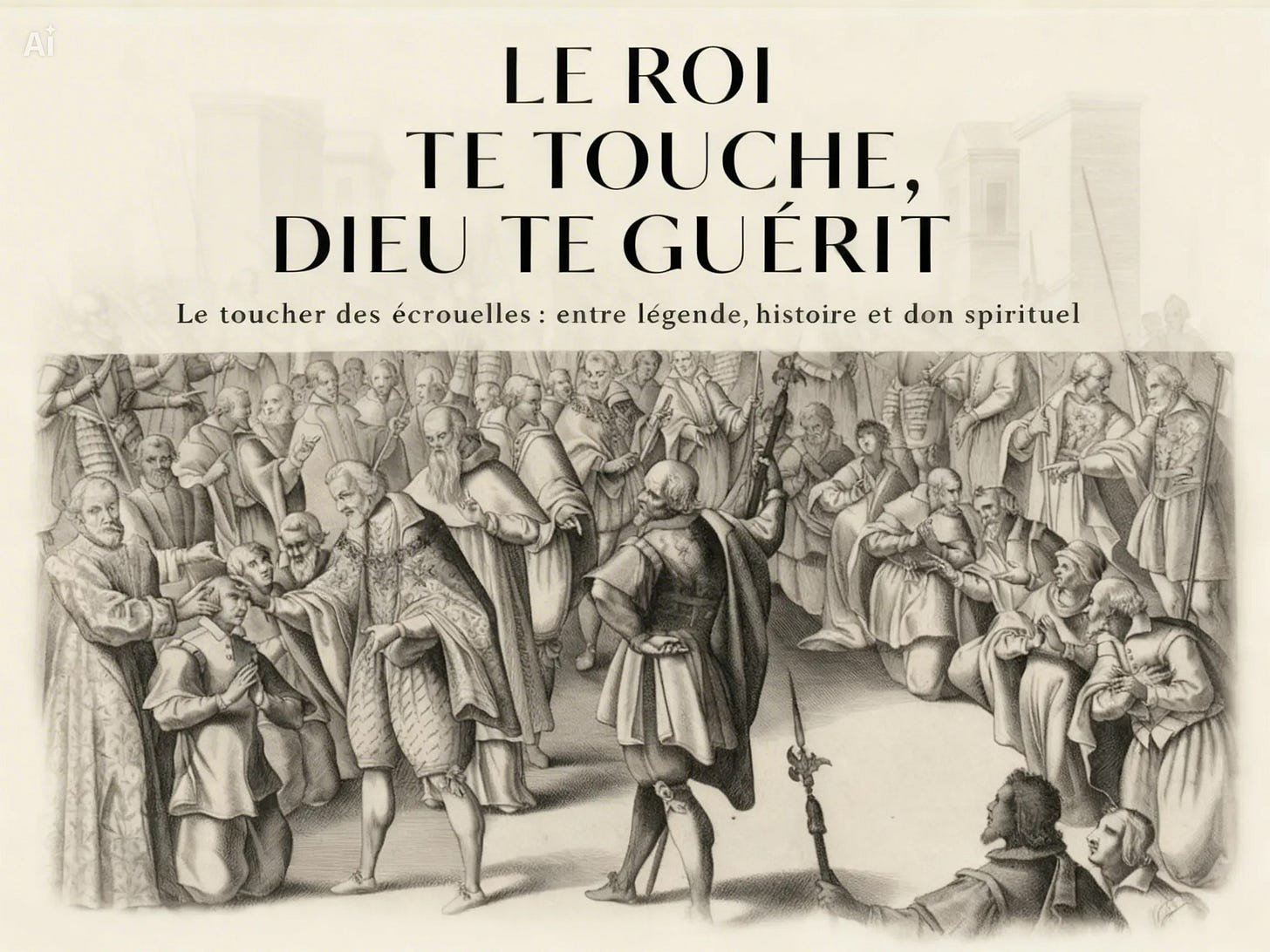
The ceremony was codified from the twelfth century onward. After his coronation at Reims, the king would approach the sick disposed in ranks, previously sorted by royal physicians. With his right hand, he would trace a sign of the cross over the swollen face and pronounce the formula:
"The king touches you, God heals you."
Six words of remarkable theological precision: God acts, the king is merely the hand. Intercessor, mediator—and not thaumaturge in his own right. This explains why, according to tradition, Philip I in the eleventh century lost this power when his faults had rendered him unworthy of being its vessel. The gift did not belong to him: it was entrusted to him, conditionally.
II. MARC BLOCH: REHABILITATING THE STRANGE
In 1924, Marc Bloch published The Royal Touch, a masterpiece of historical anthropology. This historian—who would be shot by the Gestapo twenty years later—does not seek to prove or refute the miracle. He poses a far more fruitful question: how could such a belief become established, endure for seven centuries, and ultimately fade away with Charles X in 1825?
His answer is of remarkable subtlety. The royal touch was both cause and effect of the mystical halo surrounding the sovereign. It enhanced the prestige of the monarchy—but it would never have gained credence without the unanimous conviction that recognized in the anointed king a sacred character. Bloch traces the genealogy of the rite back to Robert the Pious, fixes it under Louis VI, and shows how the privilege became hereditary: no longer linked to the personal sanctity of the prince, but to his function. The gift, transmitted with the crown and the unction.
III. THE SCALE OF A POPULAR RITE
What strikes one in the sources is the vertiginous scale of the phenomenon. The ceremony was not a confidential rite reserved for a few notables: it attracted crowds from all over Europe—Spaniards, Germans, Italians—who made the journey to approach the king. The ceremony took place up to four times a year, at the great liturgical feasts. Louis XIII touches more than 800 patients at the age of ten. Francis I receives more than 1,500 in a single day. Louis XIV, some 2,000 in 1696. Louis XVI, 2,400 at his first touching, with five cures declared by the physicians present.
The ceremony followed meticulous protocol: royal physicians, captain of the guards, ritual of hand-washing with three different towels after the touching. This last detail, studied by historian Stanis Perez, reveals something essential: the king was a man of flesh, exposed to the same contagions as his subjects, and his physicians protected him accordingly.
IV. PHYSICIANS, BETWEEN DEFERENCE AND SKEPTICISM
Grand Siècle physicians navigated troubled waters. To criticize the ritual would have been lèse-majesté; to affirm that it cured every patient, a manifest falsehood. André Du Laurens, first physician to Henry IV, attested to the royal power while surreptitiously recalling that other remedies existed. Baron Alibert, physician to Charles X, drew a clearer distinction: in his Monography of Dermatoses, he made no mention whatsoever of miraculous healing. Silence, sometimes, speaks louder than words.
Today, science has decided. Spontaneous remissions of ganglionic tuberculosis—a disease of capricious evolution—explain the declared cures. The 2 to 3% of patients claiming to be healed after the touching? Emotion, faith, what we call the psychosomatic effect. Biology, not miracle.
On May 31, 1825, Charles X touches the scrofulous the day after his coronation. Only one hundred twenty patients present themselves—a derisory number compared to the thousands of old. It was the last ceremony of its kind in the history of France. Chateaubriand, in disgrace at court, preserves the most lucid formulation:
"There is no hand virtuous enough to heal scrofula anymore, no holy vial salutary enough to render kings inviolable."
The restored monarchy played at being its own ghost. The rite survived the belief that animated it. Five years later, the Three Glorious Days swept Charles X away.
V. WHAT SCIENCE CANNOT SETTLE
Can the touching of scrofula be reduced to collective illusion? The question deserves to be posed with rigor. For the gift of healing—charism designated by the name charisma iamatum—is not a bygone antiquity. Saint Paul mentions it among the gifts of the Spirit (1 Cor 12, 9) and the Catholic Church continues to recognize it. And unexplained healings continue to be documented within the framework of beatification procedures.
The kings of France were anointed on the day of their coronation as lieutenants or intercessors between God and their people. It was not the king as individual who healed: it was the unction that constituted him as a vessel of a grace that transcended him. To reject the rite in the name of bacteriology is perhaps to confuse two orders of reality. That scrofula is of tuberculous origin, no one contests. That divine grace can act through human signs is an assertion that belongs to a register that science can neither confirm nor deny.
The longevity of the touching of scrofula—more than seven uninterrupted centuries—is a historical fact that commands respect. It says something profound about the French conception of authority. The Republic inherited the forms of the royal state—centralization, unity of command—but it secularized its legitimacy. The president is elected; the king was anointed. It is not the same thing.
Collective beliefs are historical facts no less than battles and treaties. Marc Bloch understood this better than anyone: to ignore them is to condemn oneself to understand nothing of those who shared them—and perhaps to understand nothing of oneself. The crowds of scrofulous who pressed before the royal palaces sought, in the gesture of an anointed man, the visible trace of an invisible power. Whether this power is real or symbolic, it had an effect on the world. Have we truly ceased to seek the same thing?
Eudes of Orléans
The crowds of scrofulous who pressed before the royal palaces sought, in the gesture of an anointed man, the visible trace of an invisible power. Have we truly ceased to seek the same thing?
SOURCES AND REFERENCES
1. Marc Bloch, The Royal Touch, Strasbourg, Librairie Istra, 1924 (reprint Gallimard, coll. "Bibliothèque des Histoires", Paris, 1983).
2. Stanis Perez, "The touching of scrofula: medicine, thaumaturgy and the body of the king in the Grand Siècle", Revue d'histoire moderne et contemporaine, no. 53-2, 2006.
3. Françoise Deherly, "The healing kings", Gallica / Blog BnF, July 2021.
4. Michel Andrieu, review of Marc Bloch, Revue des Sciences Religieuses, vol. 4, fascicule 4, 1924.
5. François-René de Chateaubriand, Memoirs from Beyond the Grave, 3rd part, book IX, Paris, Penaud frères, 1849-1850.
6. Saint Paul, First Epistle to the Corinthians, 12, 7-11, in The Bible (official liturgical translation), Paris, Mame-Desclée, 2013.