I. Before the Mitre, the Weapons
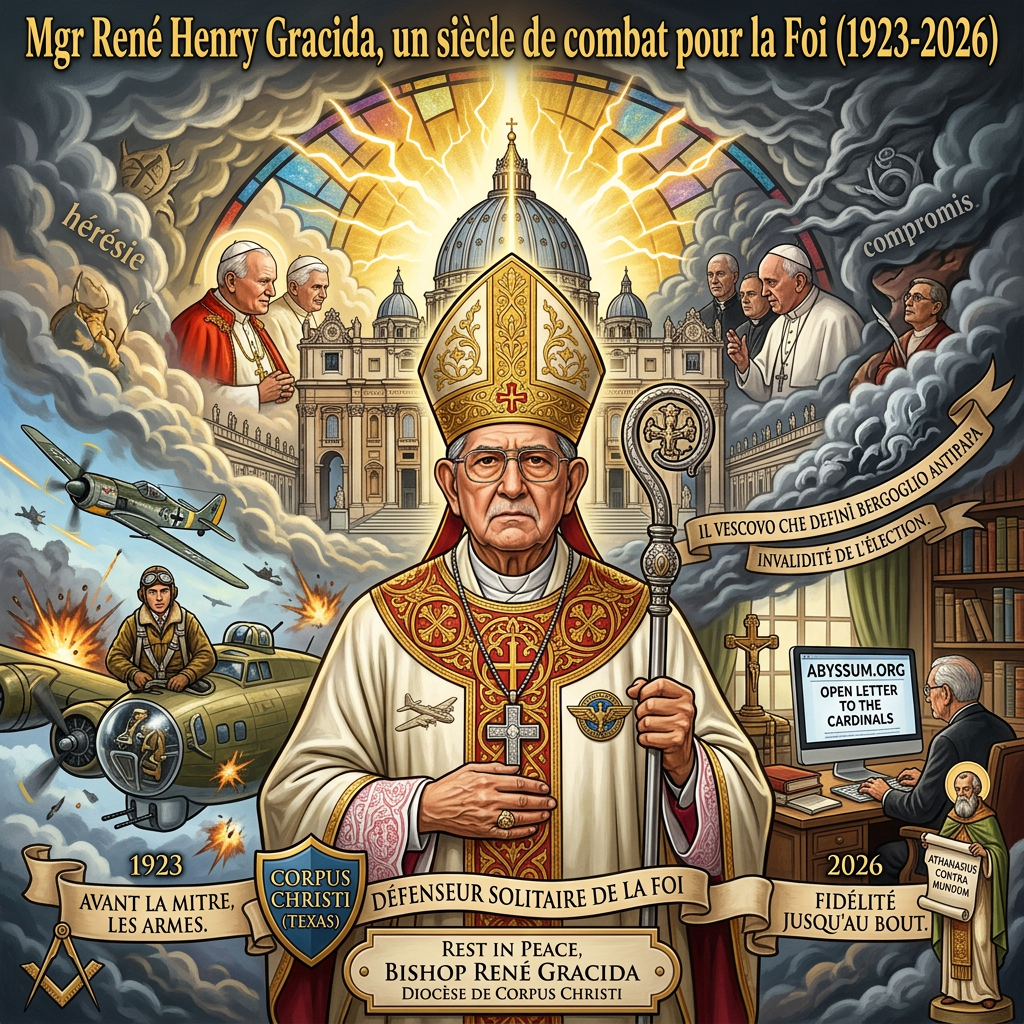
René Henry Gracida was born on June 9, 1923. Before becoming a bishop, he was a soldier. Enlisted in the United States Army Air Forces during World War II, he served as a flight engineer and machine gunner aboard B-17 bombers, surviving dozens of missions over war-torn Europe. This trial by arms in his youth would durably mark his character and the manner in which he would exercise, decades later, the episcopal ministry.
A hunter and fisherman throughout his life, this vigorous Texan was a man of the field, of patience and decision, little inclined toward the compromises dictated by fear. This military temper was not a biographical accident: it prefigured the nature of his later commitment to the Church. After working as an architect, he answered God's call, entered religious life against his father's advice, and was ordained a priest in 1958. But the former combatant had not forgotten how to hold a position under fire.
II. A Bishop of Character Bound to John Paul II
Appointed bishop by Pope John Paul II and placed at the head of the Diocese of Corpus Christi (Texas) in 1983, Bishop Gracida remained his entire life profoundly faithful to the Polish pontiff, a great fighter himself, and then to his successor. A fidelity that was rooted in the conviction that legitimate authority deserves obedience, and that communion with the Successor of Peter constitutes the heart of Catholic life.
An indefatigable pro-life activist, faithful to the line of Humanae Vitae and the Gospel of Life, he was one of the first American bishops to firmly apply canon law by refusing communion to pro-abortion politicians, braving media criticism to remain faithful to Rome's teaching. This pastor, also known as the 'savior' of EWTN, lived until the end the consistency of his faith.
This fidelity to John Paul II would precisely become, decades later, one of the springs of his resistance: for he who had been appointed by a legitimate pope could not without a struggle accept what he perceived as a usurpation of the pontifical office.
III. The Combat Against Amoris Laetitia: The Discovery of Heresy
It all began with careful reading. When Jorge Bergoglio's apostolic exhortation Amoris Laetitia was published in 2016, Bishop Gracida examined its contents with the care of a theologian and the severity of a military judge, discerning heretical propositions therein, particularly concerning the access of the divorced and remarried to Holy Communion — a complete break with the constant and irreformable teaching of the Church on the indissolubility of Catholic Marriage and the nature of the Eucharistic Sacrament.
On December 2, 2017, he became the only bishop to officially resist the sacrilege of Amoris Laetitia, declaring that Francis was teaching error: "Francis's heterodoxy is now official. He has published his letter to the bishops of Argentina in the Acta Apostolica Sedis, making these letters magisterial documents."
This was not for him a mere school quarrel: it was a betrayal of the Gospel to the detriment of the salvation of souls. For Bishop Gracida, a text that teaches error could not emanate from a legitimate papal authority. In combating this heresy, he came to an even more radical conclusion — and he took, alone or nearly so, a step that nearly the entire world's episcopate refused to contemplate.
IV. The Modern Saint Athanasius: The Declaration on the Antipope
As early as September 2017, through his blog Abyssum, Bishop Gracida had begun publicly expressing his doubts about the pontifical legitimacy of Jorge Bergoglio, making him one of the first — and the most highly qualified hierarchically — to take this step. He maintained that the 2013 election had taken place in violation of the apostolic constitution Universi Dominici Gregis of John Paul II — a violation which, according to the very terms of this document promulgated by the pope he had served, resulted in the nullity of the election.
On July 30, 2018, he published his open letter to the cardinals of the Holy Roman Catholic Church, a letter that would remain one of the most courageous acts of the contemporary episcopate. In it, he exhorts the princes of the Church to formally ascertain the invalidity of Bergoglio's election, asserting that a pope who teaches error separates himself from the Church he claims to govern.
The comparison with Saint Athanasius of Alexandria imposed itself naturally, and it was taken up explicitly in contemporary commentaries, as by journalist Fred Martinez, of the Catholic Monitor: "It was Athanasius against the world, now it is..." Just as Athanasius stood alone against almost the entire episcopate won over to Arianism in the fourth century, Bishop Gracida found himself among the very rare bishops to publicly name what he regarded as a usurpation. The formula of Benedict XVI, pronounced at the audience of June 20, 2007, resonates here as an echo: Athanasius was he who "in the midst of difficulties, sufferings and persecutions, remained steadfast in the confession of faith" — to the point that the expression Athanasius contra mundum became proverbial in the history of the Church.
Like Athanasius, Bishop Gracida accepted isolation and marginalization within the hierarchy rather than betray his conscience and his oath.
V. Toward Heaven at 102 Years: Fidelity to the End
Bishop René Henry Gracida departed peacefully toward Heaven on May 1, 2026, at the age of 102. His longevity itself seems providential: he survived long enough to see the debates he had raised continue to agitate the Church, and to remain until the end a living and uncompromising witness. Until advanced old age, he remained intellectually sharp, using modern tools — the Internet, social networks, his blog — to spread his alerts and keep alive the flame of a resistance that many deemed impossible.
The Italian website Renovatio 21 rightly presents him as "il vescovo che definì Bergoglio antipapa" — the bishop who defined Bergoglio as antipope —, thus summarizing in a single formula the trait that will doubtless remain the most salient of his memory in the history of the Church of the twenty-first century.
What Providence and Circumstances Demanded
The biography of Bishop Gracida has a trajectory of remarkable coherence. From the B-17 machine gunner surviving thirty-two missions over Nazi Germany, to the solitary bishop who publicly challenges the cardinals of Rome, it is always the same man: a fighter trained to hold his position under fire, faithful to his legitimate superiors, incapable of capitulating before what he identified as heresy.
For his supporters, for the entire Faithful Remnant, he will remain the proof that, even in the face of an apparent rout of the hierarchy, a single faithful man can embody the permanence of the Church. Bishop Gracida remained to the end what Providence and circumstances demanded: a bishop who had not forgotten, beneath his cassock, how to hold a position under fire.