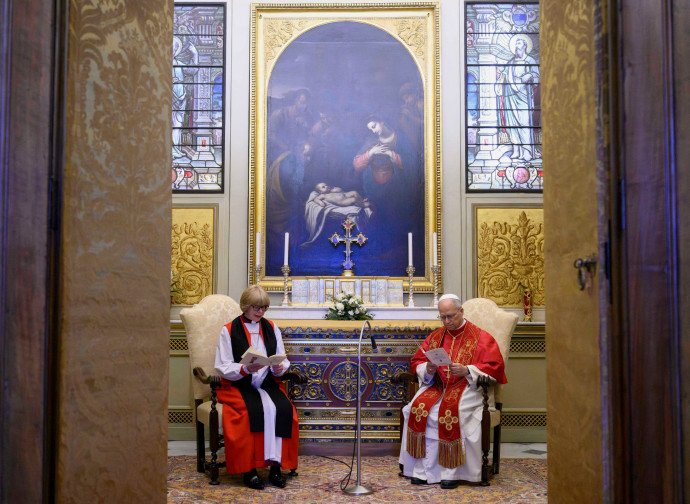
Today, Tuesday, April 28, concludes the Rome visit of Sarah Mullally, appointed Archbishop of Canterbury last October, primate of the Anglican church, and officially installed on March 25. Yesterday, the most significant stage of the pilgrimage was characterized by the meeting with Leo XIV, followed by prayer in common, in the Chapel of Urban VIII.
The Pope, who recalled the sixty years since the common declaration between Paul VI and Michael Ramsey that initiated ecumenical dialogue between the Catholic Church and the Anglican Communion, exhorted to «be steadfast in our prayers and in our efforts to remove any stumbling block that hinders the proclamation of the Gospel». Leo XIV did not, however, conceal the difficulty and complexity of this dialogue: «Although much progress has been made on historically divisive questions, in recent decades new problems have arisen, making the path toward full communion more difficult to discern. I know that the Anglican Communion too is facing many of the same questions at present».
It is not difficult to infer that one of these «new problems» that have arisen in recent decades, which is also dividing the Anglican Communion itself, was present in flesh and blood before the pope. This is not a matter of the moral qualities of Ms. Mullally, but of the objective fact that her appointment constitutes the sad consolidation of one of the most important points of rupture in the recent history of ecumenical dialogue between the Catholic Church and Anglicans, namely the possibility of conferring the sacred orders of deacon, presbyter, and bishop upon women.
The first "opening" by Anglicans to female priestly ordinations came with the Synod of 1987, whose decision was then confirmed in 1992. One would have to wait until 2008 to register the approval for episcopal ordinations in pink, which in less than twenty years brought the Anglican church, for the first time in its history, to have a woman primate. And, by a cruel irony, or, if you prefer, by tricks of Providence, the "archbishop-ess" found as her interlocutor a pontiff who bears the same name as the one who in 1896, in the apostolic letter Apostolicæ curæ, had declared in a definitive manner that Anglican ordinations were null and invalid.
It seems, however, that in the Vatican they did not properly grasp the consequences of this declaration, nor of the equally definitive teaching of John Paul II regarding the impossibility of conferring sacred orders upon women. The photograph of the
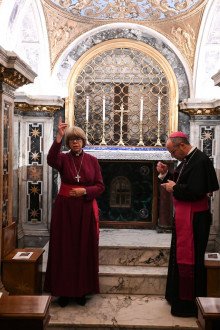
"archbishop-ess" blessing at the tomb of the Apostle Peter, with Msgr. Flavio Pace, secretary since 2024 of the Dicastery for the Promotion of Christian Unity, who bows his head and makes the sign of the cross, is causing considerable discussion. And rightly so.
There must be a problem with communications in the Vatican, not less than with blessings. And a rather serious problem. The Dicastery for the Doctrine of the Faith, with the declaration Fiducia supplicans, had presumed to bless what cannot be blessed (i.e. homosexual couples); now, the Dicastery for the Promotion of Christian Unity allows one who cannot bless to do so. Leo XIV just had time to restore the necessity that the object of the blessing be ordered, clarifying that homosexual couples cannot be blessed, but only persons, when immediately in the Vatican they made another blunder, this time regarding the subject who can impart blessings.
Certainly, even a lay person can bless someone or something, in the sense that one can invoke God's blessing, as when a parent makes the sign of the cross over their children before they go to sleep or before they leave home. But it does not appear that Ms. Mullally is the mother of Msgr. Pace and it is rather evident that the blessing gesture of the "archbishop-ess" appears decidedly priestly: the image speaks louder than many words. A bishop who bows to receive the blessing of Ms. Mullally creates at least some confusion regarding sacramentals and sacred orders, because for a normal Catholic that gesture properly indicates a priestly blessing. And Ms. Mullally is neither priest nor bishop for two reasons of extreme importance: because the ordination of a woman is null and because Anglican ordinations are invalid. This is not a question of mutual respect or liturgical hospitality, but of respecting and preserving the truth of the sacramental sign; what message is conveyed when one permits an "episcopess" to bless in the heart of the Catholic Church and when a Catholic bishop bows to receive that blessing?
The answer is not difficult; what is difficult is to think well of those who orchestrated this spectacle. It is also difficult to believe that the secretary of that Dicastery which claims to have as its guide the decree of the Second Vatican Council, Unitatis Redintegratio, has not read precisely the conclusion thereof: «This sacred Council exhorts the faithful to refrain from any levity or imprudent zeal, which could harm the true progress of unity. For their ecumenical action cannot be anything but fully and sincerely Catholic, that is, faithful to the truth we have received from the apostles and the Fathers, and in accordance with the faith that the Catholic Church has always professed».