About the project, and the doubts it raises about the Church's involvement, I wrote here. I now share with you the contribution of Tommaso Scicchitano, journalist and former priest, who sent me some reflections.
I prefer weekdays is a publication supported by readers. To receive new Posts and support my work, consider becoming a free subscriber or a paying subscriber.
Scicchitano went to see who the ecclesiastical partners of “Rebirth” are and explains what happens when the tile signing workshops for victims are set up in the same places - the Church spaces - where the abuses occurred. He also highlights that in this project, from the name itself, there seems to be no place for an unhappy outcome, for those who ultimately do not manage to “reborn”, but remain in the dark: “The good victim is the one who forgives”, writes Scicchitano. Regardless of the artist's intentions, the work “functions as a reassurance device for the ecclesial community: look, the Church recognizes. The Church repairs. The Church is reborn. But of this rebirth, who controls the narrative?”.
Happy reading, I look forward to comments.
Tommaso Scicchitano*
In Lourdes, on March 24, 2026, a group of French bishops pose for a photo holding fragments of a mosaic. They are pieces of colored ceramic, about the size of a notebook, ranging in color from dark red to slate gray. The bishops hold them in front of their chests, slightly tilted towards the lens, with an expression that oscillates between solemnity and a certain composed satisfaction. Behind them, the sanctuary. In front, the cameras.
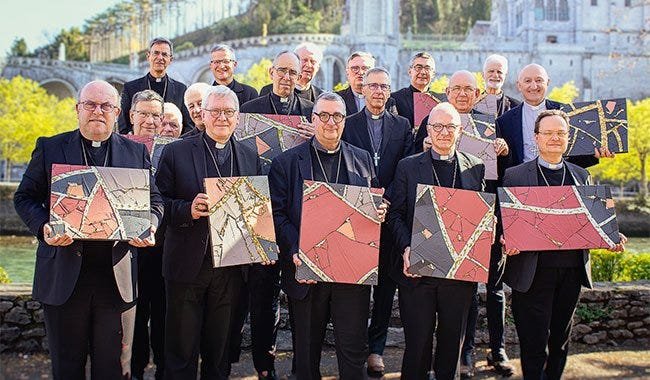
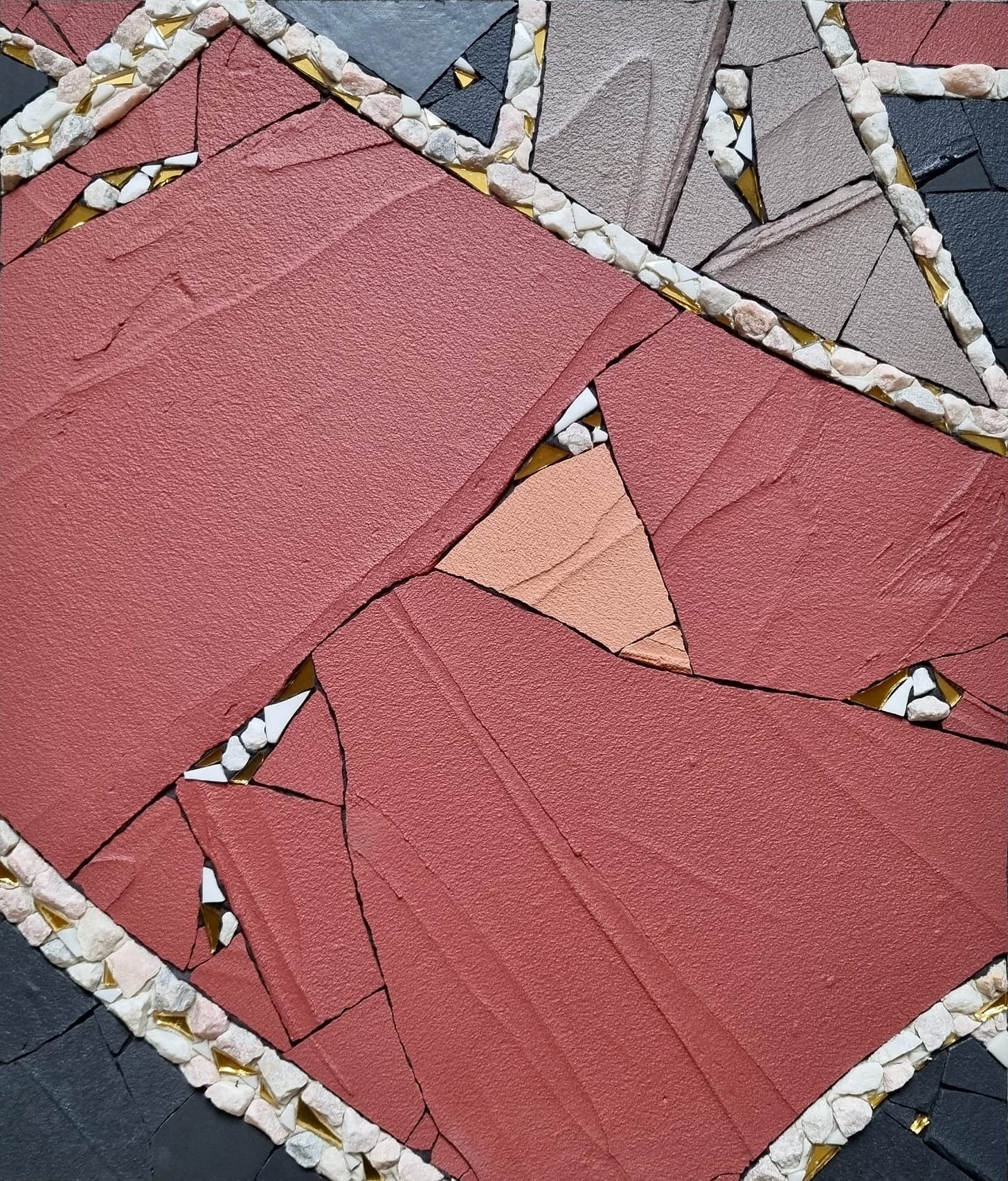
Those fragments are part of Rebirth, a monumental mosaic of 50 square meters (12.5 by 4 meters) signed by Sister Samuelle, a religious and artist. Composed as a puzzle of 200 pieces, the mosaic tells a story of repair after spiritual, psychological, and sexual abuses committed within the Church. The work will be exhibited in Paris at the beginning of 2027, then the 200 fragments will be distributed to as many places of worship, art, and learning around the world. Each fragment will be connected to the others by a QR code. A 90-minute cinematic documentary, directed by Quentin Delcourt, accompanies the project. A symphony for orchestra and choir, composed and conducted by Baptiste Capitanio, completes it.
It is an ambitious project. A beautiful project. And precisely for this reason, it deserves to be looked at carefully.
Sister Samuelle speaks in the first person. In the dossier accompanying the project, she declares that she has been a victim of abuse: “After being a victim, suffering control and abuse in silence, fear, and shame; after surviving, working to rebuild and reunify what had been shattered and dispersed, it is now time to be reborn”. Her voice is authentic, her journey legitimate, her art powerful. Those who have lived through trauma and transform it into creation perform an act of courage that is not to be questioned.
The problem is not Sister Samuelle. The problem is what happens around her work.
The tiles are small fragments of material (marble, stone, glass, ceramic) that in mosaic art compose the overall design. For the Rebirth project, Sister Samuelle creates unique tiles that travel around the world. In workshops organized in churches, monasteries, and dioceses, people who are victims of abuse and their companions are invited to sign a tile, to write a message. The fragments photographed in the dossier show handwritten words: “PARDONNER et se reconstruire”, “Pour tous les enfants violentés”, “In memory of my father who lost his faith on the day of his first confession”, “VIVRE tout simplement”. Some invoke pity, some ask for forgiveness, some thank God for coming out of silence.
The act of signing is real. Those who write their pain on a fragment of ceramic, who externalize it in an object that will become part of a collective work, perform an act of re-subjectification: from object of abuse to subject of the narrative. Psychological literature on trauma recognizes therapeutic value in these acts. The victim regains speech, inscribes it in matter, delivers it to the world.
But to whom does she deliver it?
The signing workshops take place in ecclesiastical contexts, often in the presence of bishops or religious superiors. The victim writes her message, delivers it to the Church; the Church integrates it into a work of art that celebrates its ability to welcome pain. The circuit is closed. The victim's re-subjectification is reabsorbed into the institution that produced the abuse, or that covered it up.
It is not a detail. In institutional trauma psychology, the setting in which recognition occurs is as important as recognition itself. The presence of the responsible institution at the moment of “repair” can function as confirmation of the power relationship, not as its dissolution. The victim is again a guest; welcomed, yes, but on terms dictated by the host.
The mosaic has a chromatic progression. It goes “from the darkest tones to found colors”, translating, says the dossier, “a process of reconstruction that does not erase the past but integrates it”. It is a beautiful image, and those who look at it recognize themselves in it. But it is also a narrative that prescribes an outcome. Rebirth is not one option among others: it is the obligatory destination of the work, its title, its meaning. The mosaic does not contemplate the possibility that someone does not reborn. That someone remains in the dark. That the past does not integrate but continues to devastate.
Those who have dealt with social psychology know the concept of forced narrative closure: the imposition of a positive narrative arc on experiences that may not have resolution. For victims who do not recognize themselves in the metaphor of rebirth, a work like this can function as a second form of silencing, more subtle than the first. Your pain is fine, provided it ends well. Your story is accepted, provided that its last chapter is bright.
The tiles that express anger, refusal, denunciation without redemption: where are they? The photographs in the dossier almost completely exclude them. The visual selection builds a canon: the “good” victim is the one who forgives, who thanks, who integrates. The others do not enter the frame.
The dossier lists the institutional partners of the project: the French Episcopal Conference, the Pontifical Commission for the Protection of Minors in the Vatican, the Conference of Religious and Religious of France, the Swiss CECAR, the Portuguese Grupo VITA, The Loud Fence in England, the Spanish Proyecto Repara, the French INIRR. Three hundred and fifty international contributors.
Here the project deserves to be questioned not for what it says, but for what it does not say.
The CECAR, the Swiss Commission for Listening, Conciliation, Arbitration, and Repair, is one of the most serious and independent bodies in the European landscape of restorative justice for victims of ecclesiastical abuses. Founded in 2016 at the initiative of the SAPEC Group and Swiss Catholic institutions, it is independent of the Church authorities. In its 2020 activity report, the CECAR wrote: access to archives is “difficult, even practically impossible”; we are witnesses of an “opacity in the transmission of information” by the congregations.
The pilot study by the University of Zurich on sexual abuse in the Swiss Catholic Church, presented in September 2023, documented over a thousand cases and made explicit recommendations: opening of ecclesiastical archives to researchers and victims, cessation of the destruction of relevant documents, access to Vatican archives. The Apostolic Nunciature in Bern refused to open its archives to the historians in charge of the investigation. Researchers discovered that 90% of the abusers are identifiable in the documents, but only 70% of the victims are: the Church archives tell of the perpetrators, not of those who suffered.
In France, the Independent Commission on Sexual Abuse in the Church (CIASE), chaired by Jean-Marc Sauvé, produced in 2021 a 2,500-page report that documented a “massive” and “systemic” phenomenon: at least 216,000 victims, between 2,900 and 3,200 priests and religious involved in seventy years. The Commission made 45 recommendations. It had access to the archives, but by specific concession, not by structural right. The system itself remains opaque.
These are the partners of Rebirth. Bodies that have been asking for years for what the project does not even name: documentary transparency, access to files, end of the destruction of acts, institutional accountability. The dossier of Rebirth does not contain the word “archives”. It does not contain the word “investigation”. It does not contain the word “responsibility” in the sense of documented institutional responsibility.
Let us look at the communicative architecture of the project: the dossier is quadrilingual, carefully laid out, rich in emotionally impactful photographs. The structure follows the classic model of cultural fundraising: first the work, then the context, then the participation tool (the tiles), then the amplification media (documentary, symphony), finally the call to action. It is a funnel, i.e., the process by which companies guide the customer to the purchase of a product, designed to engage. It works.
But the lexicon of the project deserves attention. “Repair”, “rebirth”, “path”, “wounds that remain present”, “living not despite but with and even through the wounds”: it is the vocabulary of resilience and spirituality, never that of justice. The framing shifts the axis from the legal-institutional plane (who did what, who knew, who covered up, where are the documents) to the therapeutic-spiritual one (the victim who is reborn, the fragment that is recomposed, the darkness that becomes light).
There is no contradiction in the dossier. There is no voice of a victims' association that asks critical questions. There is no one who says: the tile is beautiful, but where is my file? The only victim's voice is that of Sister Samuelle, who is also the artist, and whose testimony is entirely built on the key of redemption. It is a narration without dissonances.
The final sentence of the dossier is revealing: “In 2027, millions of Christians will pass in front of this work of individual and collective repair every week in the world”. The target is not the victims. The target is the faithful. The work functions as a reassurance device for the ecclesial community: look, the Church recognizes. The Church repairs. The Church is reborn. But of this rebirth, who controls the narrative?
The QR code that connects the 200 fragments is the perfect metaphor. Whoever scans it enters the world of the project: the complete work, the film, the symphony. It does not enter a database of documented cases, not an archive, not an investigation report. The QR code connects aesthetic fragments, not fragments of truth.
There is an expression in Christian theology that comes before rebirth: metanoia. The radical change, the conversion of the heart. The penitential liturgy of the Catholic tradition presupposes that the external gesture corresponds to an interior transformation. Confession without the purpose of not sinning again is form without substance. Sacrament without grace.
The Rebirth project has all the elements of a penitential liturgy: a physical gesture (the tile), a symbolic progression (from darkness to light), a participating community (victims, bishops, faithful), a work that remains as a permanent memory in places of worship. But where is the metanoia?
The archives remain closed. The files remain in the drawers of the curias. The nunciature refuses access to researchers. Documents are destroyed. The CECAR itself, which is a partner of the project, has denounced the Church's opacity. The Sauvé report, we recall, documented 216,000 victims in France and made 45 recommendations, many of which are still awaiting implementation.
The bishop signs the tile, poses for the photo in Lourdes with the fragment in hand, and returns to the curia where the files remain under lock and key.
It is not an empty gesture. It is an emptied gesture. The tile signed by the victim has an intimate, real, therapeutic value. But when the institution welcomes it without performing the acts that repair requires (transparency, access to documents, accountability), the gesture loses its transformative power. It becomes liturgy without conversion. Sacrament without metanoia.
The Rebirth project proposes an “individual and collective repair”. But individual repair and collective repair are not the same process. The first is therapeutic and concerns the subject; the second is political and concerns the institution. A mosaic can contribute to the first. It cannot contribute to the second if the institution does not perform concrete acts of transparency, responsibility, and structural reform. Putting the two dimensions on the same level, as the dossier does, is an operation that advantages those in power: “collective repair” is declared to be in effect without the institutional community having done anything structural.
Sister Samuelle may be in total good faith, indeed, she probably is. Her personal journey as a survivor who transforms trauma into art is legitimate and powerful. But the project that has arisen from it, with its institutional partners and its communicative architecture, objectively functions as a reputational management tool for the ecclesiastical institution. Not by intention of the artist; by the very structure of the device.
In Lourdes, on March 24, 2026, the bishops pose for the photo with the fragments of Rebirth. In some curia, in some secret archive to which only the bishop has access, there are the files. The names of the priests who abused. The reports of the superiors who covered up. The letters of the victims never forwarded. The silent transfers.
The fragment of the mosaic and the file of the archive are made of the same matter: the truth of those who suffered. But the fragment travels around the world, is exhibited in a wooden case, illuminated, connected to a QR code that refers to the film and the symphony. The file remains in the drawer.
When the 200 fragments are exhibited in the 200 places of worship around the world, millions of faithful will pass in front of them every week. They will see the beauty of repair. But true repair, the one that passes through documented truth, will remain where it has always been: locked away, in an archive to which only the bishop has access.
And the tile, however beautiful, is not a key.
*Tommaso Scicchitano, former Catholic minister, is a writer, journalist, and communication consultant.
(Photo Irrix Films)