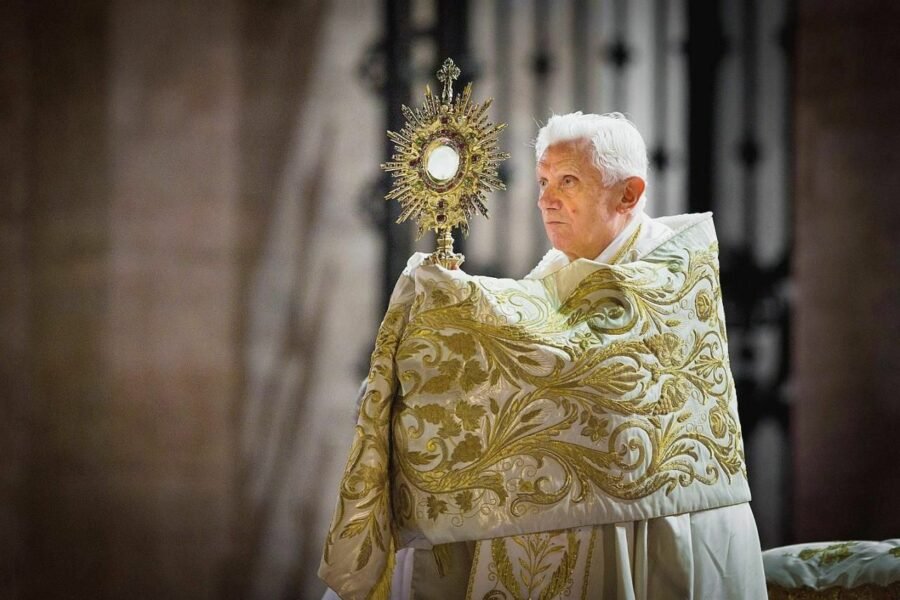
A great solemnity has risen over the world: the Feast of God, as our fathers called it, truly a feast of God, but also a feast of man, being the feast of Christ the mediator present in the Host to give God to man and man to God. Divine union is the aspiration of humanity; to this aspiration, here below, God has answered with an invention from heaven. Man celebrates today this divine marvel. (Dom Prosper Guéranger)
Let us briefly trace the history of this beautiful Feast of God, once so popular...
The feast of the Most Holy Sacrament dates from the thirteenth century. In a vision, the blessed Julienne, prioress of the monastery of Mont-Cornillon, near Liège, learned that God charged her with working with all her power to establish a feast in honour of the Holy Sacrament. Pope Urban IV made it obligatory for the entire Church in 1264 and Pope John XXII, in 1318, ordered the Eucharist to be carried in procession through the streets and roads.
A solemn procession takes place on the day of Corpus Christi to sanctify and bless, by the presence of Jesus Christ, the streets and houses of our towns and villages.
The processions of the Holy Sacrament exposed in the monstrance did not begin before the institution of Corpus Christi. However, before this time, there were processions in which the holy Sacrament was carried enclosed in a tabernacle. It was not the Holy Sacrament that was specially honoured, but Our Lord considered in some circumstance of his earthly life.
Thus, from the seventh century onwards, in some churches, the Holy Sacrament was carried in the procession intended to honour the triumphal entry of Our Lord into Jerusalem, on Palm Sunday.
The bull of Pope John XXII, ordering « the Eucharist to be carried in procession in the streets and public squares », was published in 1318; but it doubtless only confirmed a custom probably as old as Corpus Christi itself (1264).
As soon as these processions were instituted, the piety of the faithful strove to give them all possible splendour. It was in the midst of streets and squares richly adorned with draperies and garlands that the Holy Sacrament advanced, sheltered beneath a canopy to emphasize its presence all the more. It was preceded by a long file of children dressed in white, who swung censers or threw flowers, while the crowd sang the benefits of the Eucharist.
Unfortunately, today, in many cities, under the pretext of respecting freedom of conscience and not hindering traffic, Jesus in the Host can scarcely leave the churches.
The office of the Most Holy Sacrament, composed by Saint Thomas Aquinas, is an admirable exposition of Catholic teaching on the Eucharist.
The hymns Sacris solemniis of Matins, Verbum supernum of Lauds, Pange lingua of Vespers and the prose Lauda Sion, which has been called the Credo of the Holy Sacrament, are models by their doctrinal depth, their clarity-filled conciseness and their majestic simplicity.
The melodies, also very beautiful, already existed before Saint Thomas.
To celebrate Corpus Christi worthily, the faithful contribute to the splendour of the ceremonies, to the extent of their power, by adorning the streets through which the holy Sacrament passes, by attending Mass and the blessing of the holy Sacrament, and by taking part in the Procession.
Introit: Cibavit eos
This feast comprises, in addition to the Mass, the solemn procession of the Holy Sacrament through the streets, to the singing of hymns and canticles, which gave the feast its popular name of Corpus Christi, for the Eucharistic bread is adored under the appearance of which God makes himself visibly present to our eyes. This feast was fixed on the Thursday following that of the Holy Trinity, clearly in remembrance of Holy Thursday and the institution of the sacrament of the Eucharist. But in France since the Concordat of 1801, this Thursday is no longer a public holiday nor a feast of obligation, and the solemnity of the feast was transferred to the following Sunday, thus superseding the second Sunday after Pentecost. It is known that the office of this feast, including the Mass, was composed entirely by Saint Thomas Aquinas. For the chants of the proper of the Mass, he took up from the Introit and Gradual existing pieces. The others, Alleluia, Offertory, Communion are new.
For the Introit Saint Thomas Aquinas took that of Monday of Pentecost, which reminds us that in the first centuries the feast of Pentecost was a baptismal feast like that of Easter; the chants of the masses of the week of Pentecost, like those of the week of Easter, are specially addressed to the newly baptized, who are also first communicants. This is why they speak of the Eucharist which they have received for the first time. This spiritual food is evoked here by a verse of Psalm 80, an invitation to celebrate a great feast to thank the Lord for his blessings.
Cibavit eos ex adipe frumenti, et de petra melle saturavit eos.
He has nourished them with the flower of wheat, and He has satisfied them with honey from the rock.
The melody is little developed, turning simply around a few notes. It is sweet and peaceful with only a more marked accent on the word saturavit which evokes the happiness of being satisfied. This Introit is accompanied of course by the first verse of Psalm 80.
Exsultate Deo adjutori nostro : jubilate Deo Jacob.
Exult in God who is our help, shout with joy for the God of Jacob.
Gradual: Oculi omnium
Like the Introit, this Gradual of the feast of the Holy Sacrament is an old piece that was taken up for this Mass: the Gradual of the twentieth Sunday after Pentecost. The text is taken from Psalm 144, again a song of thanksgiving for all the blessings with which the Lord has filled us, and in particular the food he grants us every day, our daily bread where we see today a figure of the Eucharist.
Oculi omnium in te sperant, Domine, et tu das illis escam in tempore opportuno. Aperis tu manum tuam, et imples omne animal benedictione.
The eyes of all hope in you, O Lord, and you give them food in due season. You open your hand and fill every living creature with your blessings.
The word « animal » in Latin designates all living creatures, and first and foremost men. The melody, as is generally the case in Graduals, is made largely of formulas found in other pieces, with great vocalises. It is in particular the same one that concludes the first and second parts. This melody is ample and enthusiastic with well-balanced rises and falls embracing the full range of the octave.
Alleluia: Caro mea
The text of the Alleluia of the feast of the Holy Sacrament is taken from the Gospel of Saint John, in the discourse on the bread of life.
Caro mea vere est cibus, et sanguis meus vere est potus : qui manducat meam carmen, et bibit meum sanguinem, in me manet, et ego in eo.
My flesh is truly food, and my blood is truly drink. Whoever eats my flesh and drinks my blood remains in me and I in him.
If these words of Christ scandalized his listeners to the point that a great many of them left him, they have become familiar to us, and need no commentary. The melody is that of an existing Alleluia to which the new words have been adapted, but in a fairly happy manner. There is a contrast between the melody of the Alleluia, which develops more in the lower range than in the upper, and that of the verse, which is on the contrary held in the heights with light and enthusiastic flights, to find again only at the end the melody of the Alleluia and its depth.
Sequence: Lauda Sion
The Alleluia of the feast of the Holy Sacrament is followed by a Sequence, as at Easter and Pentecost, but that of today is much longer: it is the famous Lauda Sion. After an invitation to praise, Saint Thomas Aquinas proceeds to a precise and detailed exposition of the Catholic faith concerning the Holy Eucharist, before concluding with an invocation to Christ who gives himself to us as food so that he may lead us to heaven.
This Sequence consists of twenty-four strophes whose melodies repeat two by two (with one exception: seven and eight repeat five and six); each strophe is formed of three short verses of eight, eight and seven feet, but at the end they expand: from the nineteenth onwards, the strophes have four verses, three of eight and one of seven feet, and the last two even have five verses, four of eight and one of seven feet. Since this piece is very long, we do not reproduce the Latin text here, and give only the translation:
Sion, praise thy saviour, thy chief and thy shepherd with hymns and canticles.
Dare as much as thou canst, for he is above all praise, and thou canst not suffice to praise him.
Today a special theme of praise is proposed: the living bread that gives life.
It is this bread that was given without ambiguity to the group of the twelve brothers on the table of the holy Supper.
Let thy praise be full, sonorous and joyful, magnificent jubilation of the soul.
Behold in deed the solemn day when we celebrate the first institution of this banquet.
The table of the new King, the new Passover of the new law puts an end to the ancient practice.
The new succeeds the old, truth chases the shadow, light dispels the night.
What Christ accomplished at the Supper, he ordered to be done in remembrance of Him.
Instructed by this sacred institution, we consecrate the bread and wine as a host for our salvation.It is a dogma for Christians: the bread is changed into flesh and the wine into blood.
What thou dost not understand and seest not, a living faith attests beyond the order of things.
Under changed appearances, by signs only and not by realities, are hidden sublime things.Flesh is food and blood is drink, but Christ remains whole under each species.
He is neither broken, nor torn, nor divided by him who takes him, but is received whole.
One receives him, a thousand receive him, these as much as that one, and he is absorbed without being consumed.
The good receive him, the wicked receive him, but what different fate! life or death.
Death for the wicked, life for the good: see the opposite effects of one and the same absorption.
If the sacrament is divided, hesitate not, remember that it is hidden as much in one particle as in the whole.No division of the thing, only the sign is broken: neither the nature nor the greatness of what is signified is diminished.
And here are the four last strophes which are often sung apart from their context at the Benediction of the Holy Sacrament:
Behold the bread of Angels become the nourishment of travellers, true bread of the sons that must not be cast to the dogs.
It is designated in figure when Isaac is offered, the Paschal Lamb sacrificed, the manna given to our fathers.
Good shepherd, true bread, Jesus, have pity on us, feed us, protect us, make us see the sovereign good in the land of the living.
You who know and can all things, who feed us here below, make us there above the table companions, coheirs and companions of the citizens of heaven.
The melody is entirely syllabic and of great amplitude, rising very high and descending very low but always very affirmative.
Offertory: Sacerdotes
For the Offertory of the feast of the Holy Sacrament, Saint Thomas Aquinas chose a passage from Leviticus, a book of the Old Testament in which God gives very precise and detailed laws to the people of Israel; this passage concerns the holiness of priests:
Sacerdotes Domini incensum et panes offerunt Deo, et ideo sancti erunt Deo suo et non polluent nomen ejus.
The priests of the Lord shall offer incense and loaves to God; therefore they shall be holy to their God and shall not profane his name.
This text reminds us that in instituting the Eucharist, Christ also instituted the Priesthood, and that there can be no Eucharist without priesthood.
The melody, as is generally the case for Offertories, is calm and contemplative, but at the same time very affirmative. Note will be taken of the long sustained notes on panem angelorum, the very words taken up by Saint Thomas Aquinas in the Sequence Lauda Sion.
Communion: Quotiescumque
For the Communion of the feast of the Holy Sacrament, Saint Thomas chose a passage from the Epistle of Saint Paul to the Corinthians which is read at Mass:
Quotiescumque manducabitis panem hunc et calicem bibetis, mortem Domini annutiabitis donec veniat ; itaque quicumque manducaverit panem vel biberit calicem Domini indigne reus erit corporis et sanguinis Domini.
For as often as you eat this bread and drink this cup, you proclaim the Lord's death until he comes; therefore whoever eats the bread or drinks the cup of the Lord in an unworthy manner will be guilty of profaning the body and blood of the Lord.
Unfortunately, as at the Offertory, the melody was modelled on that of the Communion of Pentecost, but it is even less suitable: the melody full of movement which wonderfully conveyed the irruption of the Holy Spirit in the Cenacle adapts very poorly to a didactic text, and moreover much longer.