There are flip-flops, and then there is Taylor Marshall.
Ordinary people change their minds because they discover a new fact or lose an argument. Marshall manages something more athletic. He can travel from one side of a traditional Catholic controversy to the other while continuing to insist that he has occupied precisely the same square of theological real estate the entire time.
Nothing changed.
Taylor is still Taylor.
The SSPX changed. The circumstances changed. The parchment changed. The wind changed. Possibly the barometric pressure over Écône changed.
Just do not say Taylor Marshall changed.
The remarkable thing is that Marshall himself has supplied nearly every piece of evidence necessary to prosecute the case. Hiraeth was pointing out this tendency long before July. Last August I wrote “Which Way Today, Tay?” about his abrupt softening toward Leo XIV after having identified Robert Prevost before the conclave as a nightmare scenario. In July, after the SSPX consecrations, I followed it with “Spin, Taylor, Spin,” mocking the peculiar theology of a man whose conclusions seem to become considerably less certain when yesterday’s resistance creates problems for today’s ecclesiastical positioning.
The intervening weeks have aged the joke beautifully.
From Twelve Bishops to Four Bishops Being an Outrage
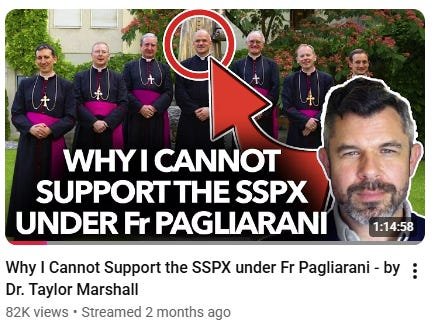
Start with the most delicious admission in Marshall’s July 7 podcast.
Before the July 1 episcopal consecrations, Marshall says, “I had been supportive of the SSPX.” How supportive?
“At one point, I even said maybe they should be making 12 bishops, two for each continent, not just four.”
Then he watched the ceremony.
The SSPX produced the text explaining its claimed mandate of necessity, and Marshall experienced “a sense of deep dread.” He says that when he saw the rolled parchment with its red ribbon, “I knew everything had changed.”
Apparently the difference between Taylor Marshall believing twelve bishops might be prudent and Taylor Marshall condemning four bishops as an ecclesiastical disaster was a ribbon.
This is magnificent.
Imagine being Fr. Davide Pagliarani. A prominent traditional Catholic commentator is publicly musing that perhaps your worldwide Society needs twelve new bishops. You consecrate four. A week later the same commentator is staring mournfully into a camera wondering where you got the audacity.
Marshall’s defense is that he never endorsed consecrations without a Roman mandate.
This is absurd because Marshall knew the Society had no Roman mandate before the consecrations took place. But even if we were to believe this, it does not erase the obvious continuity between the issue he previously recognized and the necessity claim the SSPX eventually acted upon. If Marshall thought a Society with aging bishops and a worldwide apostolate might reasonably need twelve successors, then the underlying episcopal need did not suddenly evaporate when Leo told the Society no.
The SSPX’s argument was never that July 1 possessed mystical properties.
Its argument was that Rome had been approached repeatedly, doctrinal disagreement remained unresolved, its existing bishops were aging, and provision for episcopal continuity could no longer be left indefinitely in the hands of authorities actively hostile to the Society’s theological position. The SSPX’s chronology records repeated contacts with Rome, including requests for an audience with Leo, meetings with Cardinal Fernández, correspondence, submission of the candidates’ dossiers, and appeals continuing into June.
Marshall cannot behave as though Pagliarani woke up one morning, found four spare mitres in the sacristy, and announced July 1 for the fun of it.
The Terrifying Red Ribbon

Marshall keeps returning to that parchment.
The ceremony asked for the apostolic mandate. The Society had none from Leo. Instead, a text was read asserting the Church’s necessity and the Society’s justification for proceeding.
Marshall calls this “dissimulation.” He repeatedly describes it as a “fake mandate.” In his telling, the rolled parchment seems to have acquired approximately the theological significance of Martin Luther’s hammer.
Yet the Society was not secretly pretending Leo had signed a document.
Everybody on earth knew Leo had refused permission.
The SSPX knew it. Rome knew it. The thousands attending knew it. Anyone who had opened a Catholic news site during the preceding five months knew it.
The Society was making precisely the same claim Archbishop Lefebvre made in 1988: that an extraordinary necessity supplied the moral basis for an act normally requiring papal authorization. Calling this argument a scheme to fool people into thinking there was an actual papal mandate borders on parody.
The SSPX even publicly described the ceremony afterward as one conducted without pontifical mandate and defended it on the basis of necessity.
Some deception.
Marshall himself admits that before July 1 he understood the argument and had been sympathetic enough to suggest twelve bishops. Then the ceremonial expression of the argument gave him “dread.”
Apparently sacramental theology now turns on stationery.
“I Haven’t Changed, Guys”
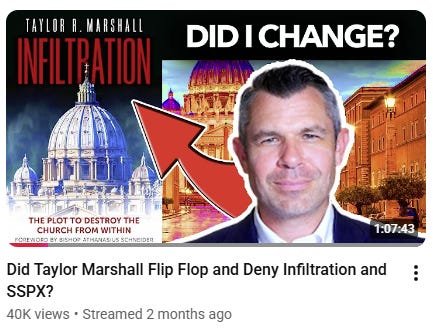
Marshall devoted an entire July 23 program to the allegation that he had flip-flopped.
“I didn’t change, guys. I’m the same Taylor Marshall,” he insists. What changed was the SSPX.
He then reaches for his 2019 book, Infiltration, to prove his consistency. In that book he rejected sedevacantism and defended recognize-and-resist. He still does, he says. Therefore there has been no change.
That is a lawyer answering a question nobody asked.
The accusation is not that Taylor secretly became a sedevacantist in 2024 and returned to recognize-and-resist in 2026.
It is that the practical content of his “resistance” seems to shrink every time resistance reaches the point where something serious is demanded.
Under Francis, resistance sounded heroic. Marshall built an enormous audience chronicling infiltration, corruption, liturgical revolution and the failures of Roman authority. He invoked Galatians 2:11: Paul resisted Peter “to his face.”
Then Leo arrives.
Suddenly we hear: calm down. Give him time. Do not judge. Let “the graces of the papacy take effect.” Marshall explicitly complains that sedevacantists are trying to push people into rejecting Leo and casts his own role as slowing everyone down.
This is recognize-and-resist after the resistance has been placed in a childproof container.
Recognize Leo.
Recognize his authority.
Recognize his restrictions.
Recognize his condemnation of the SSPX.
Recognize his continued retention of Francis’s liturgical regime.
And resist principally by making another YouTube video explaining why we should remain calm.
St. Paul at Antioch has become St. Paul waiting to see how the next quarterly personnel appointments turn out.
Leo Receives an Unlimited Credit Line

Marshall’s treatment of Leo may be the clearest example of the problem.
By late July, Marshall was already acknowledging that Cardinal Roche believed Summorum Pontificum would not return and that Leo had provided no evidence of reversing Traditionis Custodes. He described Francis’s restrictions as a “dark day of infamy” that had closed traditional Mass locations throughout the world. Yet his instinct remained to distinguish Leo from the program being carried out under Leo.
In August, Marshall went further. He conceded that Leo seemed “slightly opposed” to the traditional Mass, but then produced an elaborate psychological excuse. Leo was raised in the Novus Ordo. He was a missionary. Priests often do not think very deeply about liturgy. This probably is not “sinister” or “malicious.” It is mostly older clergy doing what they know.
This is what Hiraeth has been documenting since 2025.
Under Francis, adverse acts were evidence.
Under Leo, adverse acts require a biography.
Francis restricts the Mass: persecution.
Leo leaves the restrictions intact: perhaps he has not thought deeply enough about vestments.
Francis’s Vatican attacks Tradition: revolution.
Leo’s Vatican attacks the SSPX: unfortunate personnel management.
The theological principle appears to be that every man elected after Francis receives one complimentary year of ecclesiastical innocence.
Taylor Discovers That Francis Might Be an Intercessor
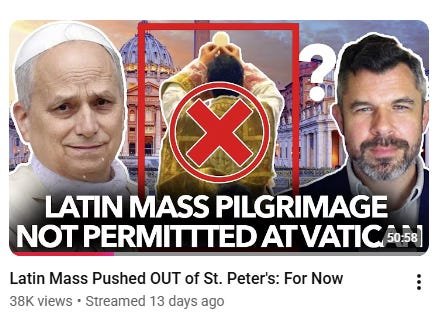
Then Marshall outdoes himself.
On September 10 he discusses the traditional pilgrimage being moved from St. Peter’s to St. Mary Major. He notes that St. Pius V is buried there. Naturally, Marshall prays at the tomb of the great Dominican pope associated with the traditional Roman rite.
Then he walks over to Francis.
Marshall says:
“I pray for him and I ask him to pray for me.”
A few seconds later he says he entrusts Francis “to the mercy of God.”
Read those two thoughts together.
Marshall prays for Francis because Francis may require mercy after death.
Marshall asks Francis to pray for Taylor as though Francis is already enjoying the beatific vision.
Pick a lane, Doctor.
There is a legitimate Catholic distinction worth making. Private requests for intercession are not identical to the public cult of a canonized saint. Indeed, causes of canonization historically gather reports of favors attributed to a deceased person’s intercession, while canon law reserves public veneration to those officially numbered among the blessed or saints.
So the problem is not simply, “Francis has not been canonized, therefore no private Catholic could ever ask him to pray.”
The problem is the breathtaking presumption in this particular case.
Francis did not die with a widely established traditional reputation for sanctity. He died after a pontificate marked by enormous doctrinal controversy. In 2017 Catholic clergy and scholars issued a formal filial correction accusing him of propagating seven heretical propositions concerning marriage, morality and the Eucharist.
Francis later signed the Abu Dhabi document stating that the “pluralism and diversity of religions” are willed by God. He approved Fiducia Supplicans, opening the door to non-liturgical blessings of same-sex couples. His pontificate generated dubia precisely because cardinals believed fundamental questions concerning revelation, sexual morality and Church teaching required clarification.
Traditional Catholics spent a decade watching Marshall explain why all of this was catastrophic.
Now he stands at Francis’s grave and asks Francis to put in a word for him.
You cannot make satire compete with this.
The old Taylor Marshall would have made a seventy-minute episode about another traditional Catholic influencer doing exactly the same thing.
The new Taylor Marshall calls it touching.
The Man Who Wrote “Infiltration” Now Needs a Safe Word
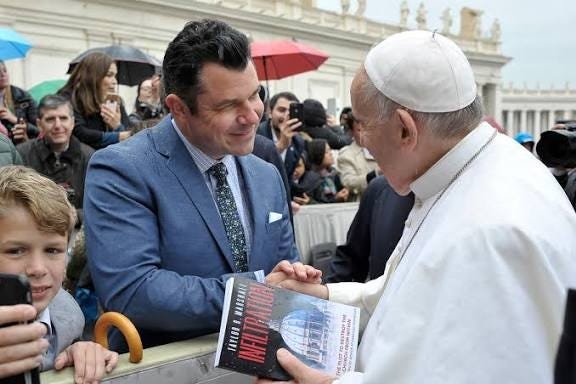
There is an even deeper contradiction here.
Marshall still says the thesis of Infiltration is true. Modernists infiltrated the institutional Church. Wolves entered wearing sheep’s clothing. The crisis is real. The liturgical reform contains fabricated innovations. The Novus Ordo has elements that did not organically develop from the Roman tradition. He says all of that himself even while discussing Leo’s defense of the reformed liturgy.
Wonderful.
Then draw the conclusion.
If the infiltration Marshall spent years documenting penetrated episcopal appointments, seminaries, the Curia, liturgical reform and doctrinal life, why does the arrival of another product of that institutional structure suddenly create a presumption that everything flowing from the office deserves near-limitless deference?
Marshall’s solution is always the same contradiction: the Church has been profoundly infiltrated, but the mechanism through which the infiltrators exercise authority must be trusted whenever it produces a concrete command.
That is how you write Infiltration and end up scolding Archbishop Lefebvre for resisting the infiltrated institution. It is how you spend years documenting Francis’s doctrinal devastation and later ask Francis for prayers. It is how you suggest twelve SSPX bishops in principle and recoil from four in reality.
The emergency is always terrible until somebody actually acts as though there is an emergency.
A Traditionalist Weather Vane With a Doctorate
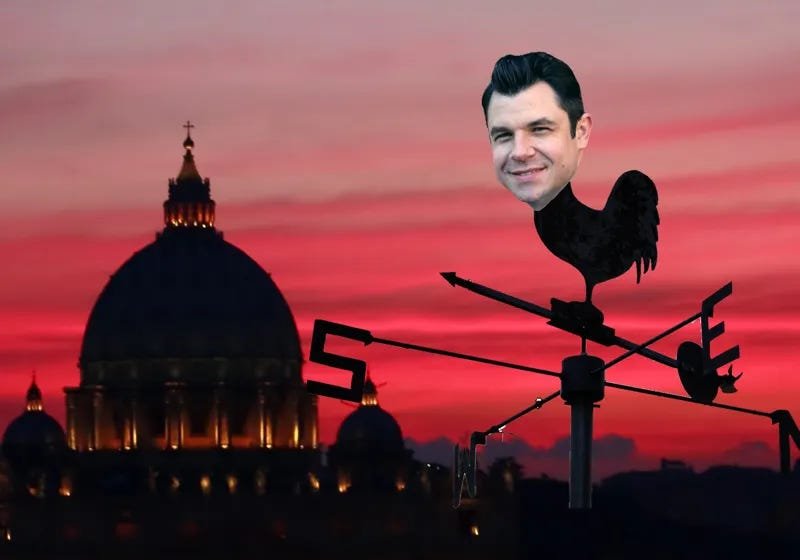
Marshall is certainly entitled to reconsider his opinions.
People should change their minds when evidence warrants it.
What becomes ridiculous is the endless insistence that no change occurred.
He told his audience four bishops might be too few.
Four appeared.
He turned on the decision.
“I haven’t changed.”
He spent the Francis years popularizing resistance to corrupt Roman authority.
Leo arrived.
Now prudence means waiting, withholding judgment and allowing the mystical “graces of the papacy” more time to mature.
“I haven’t changed.”
He chronicled Francis’s doctrinal wreckage for years.
Now he visits the man’s tomb, prays for his soul and simultaneously requests his intercession.
Still the same Taylor.
At some point consistency becomes unfalsifiable. Whatever Marshall says today proves he believed it yesterday because Taylor Marshall assures us Taylor Marshall has always been Taylor Marshall.
Perhaps that is the real doctrine holding the entire system together.
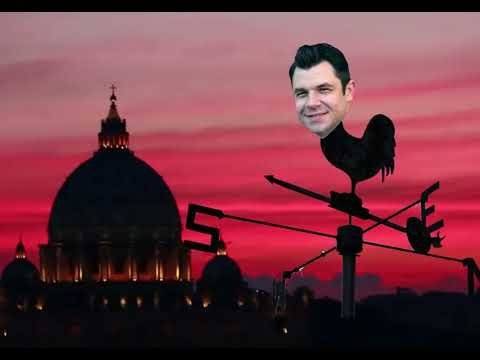
Hiraeth called him a weather vane last year.
I owe weather vanes an apology.
At least they admit when the wind changes.